
Follicular Unit Excision (FUE) has become an important technique in modern hair restoration. However, the quality of an FUE procedure depends on several factors, including the surgeon’s expertise, patient-specific follicular anatomy and the instruments selected for the procedure.
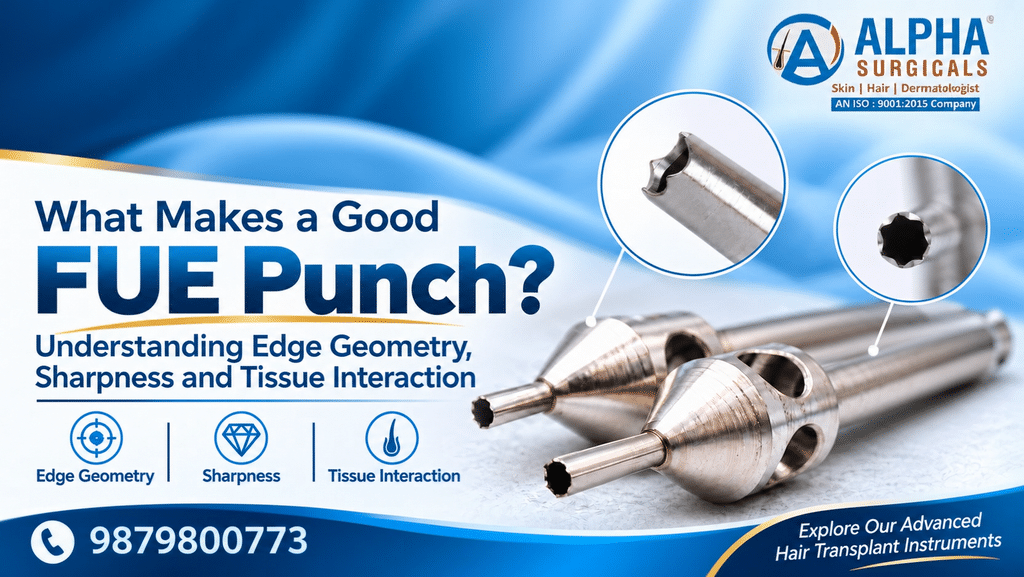
Among these instruments, the FUE punch plays an important role in follicular unit excision. Its design, edge geometry, sharpness and interaction with surrounding tissue can influence graft integrity and the overall harvesting process.
So, what makes a good FUE punch?
A well-designed FUE punch should balance cutting characteristics, controlled tissue interaction, dimensional consistency and compatibility with the intended surgical technique. Understanding these factors helps hair restoration professionals evaluate instrument design more effectively.
What Is an FUE Punch?
An FUE punch is a small, hollow surgical instrument used during follicular unit excision to separate individual follicular units from the surrounding scalp tissue.
Unlike traditional strip harvesting, FUE involves the individual removal of follicular units from the donor area. Therefore, instrument design is an important consideration.
Different FUE punches feature variations in:
- Cutting-edge geometry
- Tip sharpness
- Outer and inner wall design
- Diameter and dimensional consistency
- Material quality and surface finish
- Compatibility with manual or motorized systems
These characteristics influence how the instrument interacts with tissue and how effectively the follicular unit can be preserved.
1. Edge Geometry: The Foundation of FUE Punch Design
Edge geometry is one of the most important characteristics of an FUE punch.
It describes the shape, configuration and orientation of the cutting edge. Even small differences in edge design can influence the instrument’s interaction with skin and surrounding follicular structures.
Sharp Edge Design
Sharp punches feature a cutting edge designed to penetrate tissue with relatively low resistance.
Their performance depends on consistent manufacturing quality and appropriate instrument characteristics. However, sharpness alone does not determine overall punch quality.
Blunt Edge Design
Blunt punches have a different edge configuration. Rather than relying primarily on a sharp cutting surface, their design emphasizes controlled tissue separation.
This approach reflects a different instrument philosophy and may be suitable for particular clinical techniques.
Hybrid and Specialised Edge Designs
Modern FUE instrumentation also includes hybrid, flared and edge-out configurations.
These designs aim to balance initial tissue entry with the subsequent interaction between the punch and surrounding follicular structures.
There is no universally ideal edge configuration. The appropriate design depends on the surgeon’s technique, the patient’s anatomy and the characteristics of the procedure.
2. Sharpness: Why Consistency Matters
Sharpness is another important feature when evaluating a good FUE punch.
A consistent cutting edge contributes to predictable instrument performance. However, an excessively sharp or poorly finished edge does not automatically make an instrument superior.
Important quality considerations include:
- Consistency of the cutting edge
- Uniformity of manufacturing
- Surface finish and material quality
- Resistance to wear
- Dimensional accuracy
- Reliable performance over the intended service life
Instrument sharpness must be considered alongside geometry and tissue interaction rather than as an isolated specification.
3. Tissue Interaction: Understanding the Balance
During FUE, the instrument interacts with several structures, including the epidermis, dermis, follicular units and surrounding connective tissue.
The objective of instrument design is to support controlled separation while helping preserve follicular integrity.
Several factors influence this interaction:
Skin Characteristics
Skin thickness, tissue firmness and individual anatomical differences can affect how an FUE punch interacts with the donor area.
Therefore, a design that performs suitably in one clinical situation may not produce identical results in another.
Follicular Anatomy
Hair follicles do not always follow the same direction beneath the skin as the visible hair shaft.
Their orientation, curvature and relationship with neighbouring follicles make FUE instrumentation a specialised area of surgical design.
Tissue Resistance
The interaction between the instrument and surrounding tissue influences the mechanical demands of follicular unit excision.
Instrument geometry, tissue characteristics and the surgeon’s technique all contribute to this relationship.
4. Punch Diameter and Dimensional Accuracy
Punch diameter is another important design consideration.
The dimensions of the instrument influence the amount of surrounding tissue involved in follicular unit excision.
A suitable diameter must balance follicular preservation with the objective of limiting unnecessary tissue removal.
Dimensional consistency is equally important. Variations in manufacturing can affect instrument uniformity and compatibility with the intended system.
Importantly, no single punch diameter is suitable for every patient or clinical situation. Selection requires professional assessment of individual follicular characteristics and surgical requirements.
5. Material Quality and Surface Finish
A high-quality FUE punch requires more than an appropriately designed tip.
Material selection and manufacturing precision also influence instrument quality.
Important considerations include:
- Medical-grade material suitability
- Consistent surface finish
- Dimensional stability
- Corrosion resistance
- Manufacturing precision
- Compatibility with applicable sterilisation and reprocessing requirements
A smooth, consistently manufactured instrument reflects attention to quality and helps support dependable clinical instrumentation.
6. Sharp, Blunt and Hybrid FUE Punches: Understanding the Differences
Different punch configurations have been developed to address the varying characteristics of follicular anatomy and surgical techniques.
| Punch Type | General Design Characteristic |
|---|---|
| Sharp punch | Features a defined cutting edge |
| Blunt punch | Emphasises tissue separation |
| Hybrid punch | Combines different edge characteristics |
| Flared punch | Features an expanded or trumpet-like profile |
| Edge-out punch | Places the cutting edge towards the outer diameter |
Each design has advantages and limitations. Research does not establish one universally superior punch for every clinical situation.
Consequently, instrument evaluation should consider the complete design rather than relying on one feature alone.
7. What Should Professionals Evaluate in a Good FUE Punch?
When evaluating FUE instrumentation, hair restoration professionals can consider several broad quality parameters:
- Edge consistency: Is the cutting-edge finish uniform?
- Geometry: Is the edge configuration appropriate for the intended instrument design?
- Material quality: Does the instrument meet relevant quality requirements?
- Dimensional accuracy: Are manufacturing dimensions consistent?
- Surface finish: Is the instrument free from visible manufacturing irregularities?
- System compatibility: Is it compatible with the intended professional equipment?
- Quality assurance: Are suitable inspection and quality-control processes documented?
These considerations help distinguish overall instrument quality from specifications that may appear impressive but do not independently establish clinical performance.
8. The Importance of Choosing Quality Hair Transplant Instruments
Hair restoration requires specialised instruments designed around the technical and anatomical demands of the procedure.
A well-engineered FUE punch is one component of this broader instrumentation system. However, clinical outcomes also depend on professional expertise, patient selection, appropriate planning and careful surgical judgement.
For this reason, instrument quality should be evaluated through design, manufacturing consistency, documentation and professional suitability.
How Alpha Surgical Supports Professional Hair Restoration Instrumentation
At Alpha Surgical, we understand the importance of precision, reliability and quality in professional surgical instrumentation.
We focus on supporting dermatology, aesthetic medicine and hair restoration professionals with instruments and solutions designed around practical clinical requirements.
From FUE instrumentation to specialised hair transplant accessories, selecting suitable professional equipment is an important part of maintaining a quality-focused clinical environment.
As hair restoration technology continues to evolve, Alpha Surgical remains committed to highlighting the importance of instrument design, manufacturing quality and professional requirements.
Conclusion
A good FUE punch is defined by more than its sharpness. Edge geometry, tissue interaction, dimensional accuracy, material quality and manufacturing consistency all contribute to its overall design.
Different punch configurations offer different characteristics, and no single design is ideal for every clinical situation.
Understanding these factors helps hair restoration professionals make more informed decisions when evaluating FUE instruments.
Alpha Surgical believes that precision begins with understanding instrument quality.
For professional surgical and hair restoration instrumentation enquiries, contact Alpha Surgical.
Call: 9879800773
Frequently Asked Questions (FAQs)
1. What makes a good FUE punch?
A good FUE punch combines appropriate edge geometry, consistent sharpness, dimensional accuracy, suitable material quality and predictable tissue interaction.
2. Why is edge geometry important in FUE punches?
Edge geometry influences how the instrument interacts with skin and surrounding follicular structures. Different configurations are designed to address different tissue and anatomical considerations.
3. Are sharp FUE punches better than blunt punches?
Not necessarily. Sharp and blunt punches have different design characteristics. Their suitability depends on the surgeon’s technique, follicular anatomy and clinical requirements.
4. What is a hybrid FUE punch?
A hybrid FUE punch combines different edge characteristics within its design. It aims to balance tissue entry and tissue separation.
5. Does punch diameter affect graft quality?
Punch diameter can influence the amount of surrounding tissue involved during excision. Its suitability depends on follicular characteristics and the surgeon’s clinical judgement.
6. Why does material quality matter in FUE instruments?
Material quality influences dimensional stability, surface finish, durability and compatibility with applicable sterilisation and reprocessing requirements.
7. Which factors should professionals consider when evaluating an FUE punch?
Professionals should consider edge geometry, sharpness consistency, dimensions, material quality, manufacturing precision, system compatibility and documented quality assurance.
8. Where can professionals enquire about hair transplant instruments?
Professionals can contact Alpha Surgical for enquiries about its range of professional surgical and hair restoration instrumentation.
Alpha Surgical Contact Number: 9879800773
Follow us on Instagram : https://www.instagram.com/alphasurgicals?igsh=cTdjYWNtaXkxazlr
Follow us on Facebook : https://www.facebook.com/alphasurgicals/
Watch and learn suturing techniques : https://alphasurgicals.com/educational-surgical-videos/
Visit our store to purchase other products : https://alphasurgicals.com/store/