
Vitiligo is a skin condition that causes areas of skin to lose their natural pigment. Treatment depends on the type of vitiligo, disease stability, affected areas, and the patient’s clinical condition. In selected stable cases, dermatological surgery may be considered as part of a repigmentation treatment plan.
Therefore, choosing suitable vitiligo surgery instruments can help healthcare professionals perform procedures with appropriate precision and control.
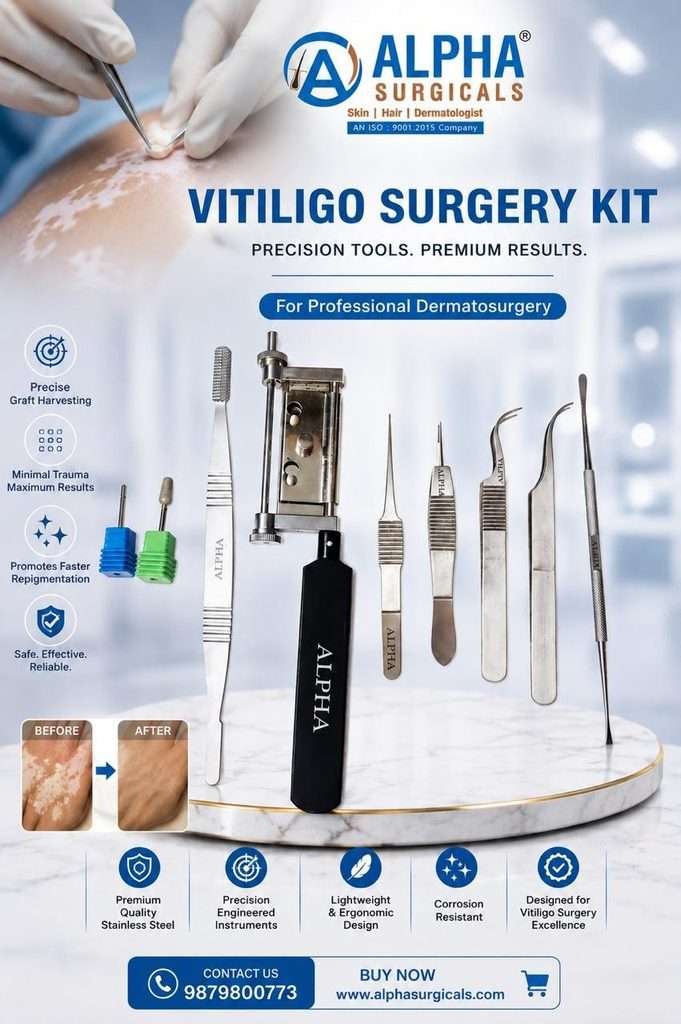
What Are Vitiligo Surgery Instruments?
Vitiligo surgery instruments are specialized dermatological tools used during surgical procedures that aim to restore pigmentation in selected patients.
These instruments can support different stages of treatment. For example, some tools help obtain skin grafts, while others assist with handling, preparing, or placing tissue.
Moreover, the exact instruments required depend on the surgical technique and the clinician’s preferred workflow.
Types of Vitiligo Surgery Instruments
Different procedures require different instruments. However, several commonly used categories can be found in dermatological surgical workflows.
1. Biopsy and Skin Punches
Skin punches can be used to obtain small circular tissue samples or grafts in selected procedures.
Depending on the technique, the clinician may choose an appropriate punch diameter for the required tissue size. Consequently, punch selection should match the procedure and clinical requirement.
2. Tissue Forceps
Forceps help clinicians handle delicate tissue during surgical procedures.
Fine and precise forceps can provide controlled tissue handling. In addition, the appropriate forceps design can support careful graft manipulation while reducing unnecessary pressure on the tissue.
3. Surgical Scissors
Surgical scissors are used for controlled cutting and tissue preparation.
Different blade designs serve different purposes. Therefore, clinicians should select scissors according to the procedure and tissue-handling requirements.
4. Grafting Instruments
Some vitiligo procedures involve harvesting or transferring skin or cellular material.
For this reason, suitable grafting instruments can support preparation and placement during the procedure. The specific tools vary according to the selected surgical method.
5. Dermatological Blades and Surgical Tools
Certain procedures may require fine blades or other precision instruments for preparing the treatment area or handling tissue.
Furthermore, sharp and well-maintained instruments can support controlled clinical workflows when used by trained professionals.
Common Vitiligo Surgical Techniques
The instruments used in vitiligo surgery depend largely on the selected technique.
Punch Grafting
Punch grafting uses small skin grafts obtained from a donor area and placed into selected recipient areas.
Accordingly, punch instruments and tissue-handling tools can form an important part of this workflow.
Suction Blister Grafting
Suction blister grafting involves preparing tissue from a donor area before transferring suitable epidermal tissue to the recipient site.
Therefore, the procedure may require specialized equipment and delicate tissue-handling instruments.
Non-Cultured Cellular Grafting
Non-cultured cellular grafting techniques involve preparing a cellular suspension from donor tissue and applying it to a prepared recipient area.
In such procedures, the required instruments can differ from those used for conventional grafting. Consequently, clinicians should select instruments based on the specific technique.
Melanocyte-Based Surgical Procedures
Some specialized approaches use melanocyte-containing tissue or cellular preparations to support repigmentation.
However, these procedures require appropriate clinical expertise, equipment, and patient selection.
Why Precision Matters in Vitiligo Surgery
Vitiligo surgery involves delicate skin and tissue handling. Therefore, instrument precision can contribute to a controlled surgical workflow.
Moreover, comfortable handles and suitable instrument designs can help clinicians maintain better control during detailed procedures.
At the same time, proper sterilization and instrument maintenance remain essential for safe clinical practice.
How to Choose Vitiligo Surgery Instruments
Healthcare professionals should consider several factors when selecting vitiligo surgery instruments.
Procedure Compatibility
First, match the instrument with the planned surgical technique. Different procedures require different tools.
Precision and Control
Next, consider the instrument’s tip design, size, and handling characteristics. These features can influence control during delicate procedures.
Material and Finish
High-quality surgical instruments should use suitable medical-grade materials and finishes. In addition, smooth surfaces can support proper cleaning and maintenance.
Ergonomic Design
Comfortable handling matters during procedures that require precision. Therefore, an ergonomic instrument can support consistent hand control.
Sterilization Requirements
Finally, select instruments that are compatible with the applicable cleaning and sterilization workflow.
Alpha Surgical: Vitiligo Surgery Instruments for Professional Applications
Alpha Surgical supplies professional medical and surgical products for dermatology and related healthcare applications.
Furthermore, Alpha Surgical focuses on products designed around quality, reliability, and practical clinical requirements.
The company’s dermatology instrument range can support professionals looking for precision-oriented tools for various dermatological procedures. Depending on the clinical application, the range may include punches, forceps, scissors, and other surgical instruments.
In addition, Alpha Surgical emphasizes dependable products for professional healthcare environments.
Benefits of Using Suitable Vitiligo Surgery Instruments
Selecting suitable vitiligo surgery instruments can support several aspects of a clinical workflow.
- Better procedural control
- Precise tissue handling
- Efficient instrument handling
- Suitable support for grafting workflows
- Organized surgical procedures
- Professional dermatology applications
However, instruments alone do not determine treatment outcomes. Clinical assessment, patient selection, surgical technique, aftercare, and practitioner experience also play important roles.
Conclusion
Vitiligo surgery instruments support various dermatological surgical workflows, including selected grafting and repigmentation procedures. Punches, forceps, scissors, blades, and specialized grafting tools can each serve different purposes.
Therefore, healthcare professionals should choose instruments according to the procedure, tissue-handling requirements, and clinical workflow.
Moreover, proper instrument care, cleaning, sterilization, and maintenance should always follow applicable professional protocols.
Alpha Surgical provides professional dermatology and surgical instruments designed with a focus on quality, reliability, and practical clinical use.
Explore Professional Dermatology Instruments with Alpha Surgical
For product information and professional requirements, contact Alpha Surgical.
Follow us on Instagram : https://www.instagram.com/alphasurgicals?igsh=cTdjYWNtaXkxazlr
Follow us on Facebook : https://www.facebook.com/alphasurgicals/
Watch and learn suturing techniques : https://alphasurgicals.com/educational-surgical-videos/
Visit our store to purchase other products : https://alphasurgicals.com/store/