
What Is PRP vs GFC Therapy?
PRP vs GFC Therapy is a common comparison in modern hair-restoration and regenerative treatment discussions. Both approaches use components derived from a person’s own blood, but they differ in how those components are prepared and delivered.
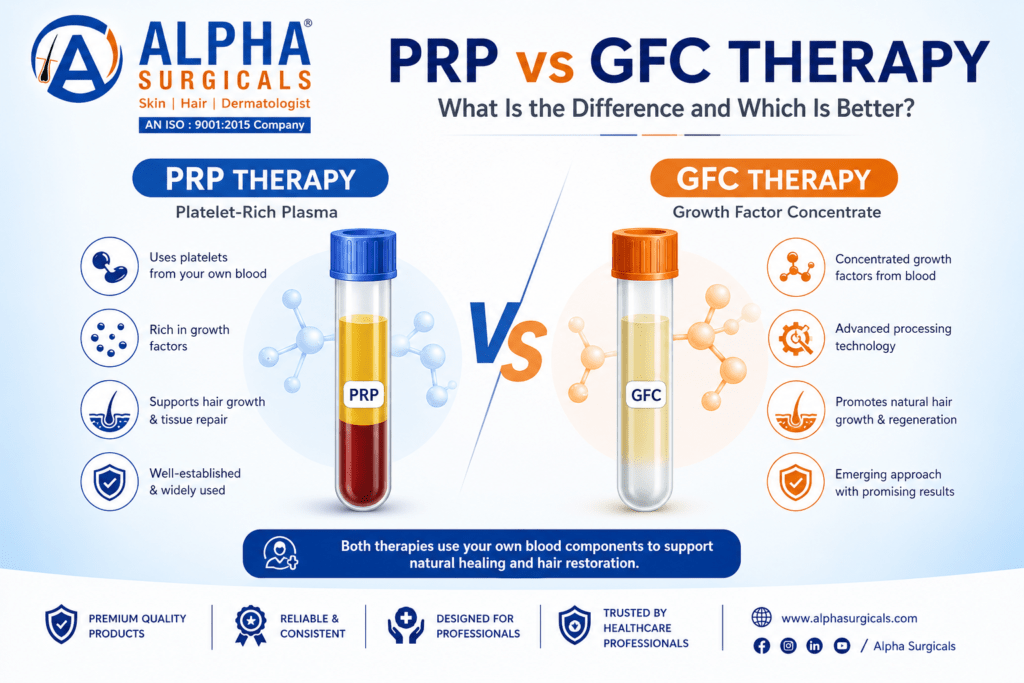
PRP (Platelet-Rich Plasma) concentrates platelets and plasma from blood. Platelets contain various growth factors and signaling molecules that may contribute to tissue repair and regeneration.
GFC (Growth Factor Concentrate) refers to a preparation designed to concentrate growth factors obtained from blood. However, GFC preparation methods can vary between systems, so healthcare professionals should consider the specific technology and protocol rather than treating every GFC product as identical.
What Is PRP Therapy?
PRP stands for Platelet-Rich Plasma.
During PRP preparation, healthcare professionals collect a patient’s blood and process it to obtain a plasma fraction with an increased platelet concentration.
Platelets naturally contain growth factors and other signaling molecules. Consequently, researchers have investigated PRP for applications including hair restoration, wound healing, scar management, and skin rejuvenation.
For hair restoration, clinicians may use PRP as an adjunctive treatment for conditions such as androgenetic alopecia.
However, PRP preparation methods vary considerably. Centrifugation protocols, platelet concentration, leukocyte content, and collection systems can influence the characteristics of the final preparation.
What Is GFC Therapy?
GFC stands for Growth Factor Concentrate.
GFC therapy uses a preparation designed to deliver concentrated growth factors obtained from the patient’s blood.
Some GFC systems use specialized collection kits and processing methods to separate and concentrate growth-factor-rich components. Therefore, the exact composition and preparation process can differ between systems.
Recent studies have investigated concentrated growth-factor approaches for androgenetic alopecia and reported improvements in measures such as hair density. However, researchers have also highlighted limitations such as small study populations, non-standardized protocols, and the need for larger controlled trials.
PRP vs GFC Therapy: Key Differences
| Feature | PRP Therapy | GFC Therapy |
|---|---|---|
| Full form | Platelet-Rich Plasma | Growth Factor Concentrate |
| Source | Patient’s own blood | Patient’s own blood |
| Main focus | Platelets and plasma | Concentrated growth factors |
| Preparation | Blood processing and platelet concentration | Specialized processing to obtain growth-factor concentrate |
| Platelets | Typically retained in the preparation | May be reduced depending on the system |
| Growth factors | Released from platelets | Concentrated according to the preparation method |
| Protocol | Varies by PRP system | Varies by GFC system |
| Standardization | Preparation varies between systems | Preparation varies between systems |
Importantly, these treatments should not be compared only by the number of growth factors. The preparation method, concentration, delivery protocol, treatment indication, and clinical evidence all matter.
PRP vs GFC Therapy for Hair Loss
Both approaches have attracted interest as supportive treatments for hair loss, particularly androgenetic alopecia.
PRP has a larger body of published literature in dermatology and hair restoration, although researchers continue to report differences in preparation methods and treatment protocols.
GFC represents a newer approach, and recent research has reported promising findings for hair density and thickness. However, the evidence remains less established than the broader PRP literature. A 2026 systematic review found encouraging results for growth-factor injections but also noted substantial heterogeneity and significant risk of bias in the available studies.
Therefore, healthcare professionals should evaluate the available evidence alongside the patient’s condition and the specific treatment protocol.
Which Is Better: PRP or GFC?
There is no universal answer to whether PRP or GFC is better.
PRP has been studied extensively and offers a well-established autologous platelet-based approach. GFC, on the other hand, focuses more specifically on delivering concentrated growth factors.
The better option depends on factors such as:
- Patient’s condition
- Treatment goals
- Preparation method
- Product or system used
- Treatment protocol
- Clinical evidence
- Healthcare professional’s experience
Moreover, current evidence does not support claiming that GFC is universally superior to PRP. Recent research describes both approaches as promising but emphasizes the need for standardized protocols and stronger clinical trials.
PRP vs GFC Therapy: Benefits
Potential Benefits of PRP
PRP may offer:
- Autologous preparation using the patient’s own blood
- Platelet-derived growth factors
- Applications in hair restoration and dermatology
- A well-established research history
- Compatibility with different treatment protocols
Potential Benefits of GFC
GFC may offer:
- Concentration of growth-factor components
- Autologous preparation
- Potential applications in hair restoration
- A targeted growth-factor approach
- Emerging evidence for hair-density improvement
However, individual results can vary, and treatment outcomes depend on the underlying condition, preparation method, and clinical protocol.
How Are PRP and GFC Different in Preparation?
The main difference lies in what the preparation aims to concentrate.
PRP preparation generally focuses on obtaining a platelet-rich plasma fraction from collected blood.
GFC preparation focuses on obtaining a growth-factor concentrate through a specific processing system.
As a result, healthcare professionals should carefully review the manufacturer’s instructions, preparation protocol, collection system, and intended clinical application before using any product.
Why Does the Preparation System Matter?
The preparation system can influence the characteristics of the final product.
For PRP, factors such as centrifugation method, platelet concentration, leukocyte content, and processing conditions can affect the final preparation.
Similarly, GFC systems can use different processing techniques and may produce preparations with different compositions.
Therefore, healthcare professionals should not assume that every PRP or GFC system produces an identical biological product.
Alpha Surgical – Supporting PRP & Hair Restoration Professionals
Alpha Surgical provides professional medical and surgical products for healthcare applications, including products associated with PRP preparation, hair restoration, and dermatology workflows.
Our focus remains on quality, reliability, and professional requirements. We aim to support healthcare professionals with products suitable for their established clinical workflows.
Whether professionals are exploring PRP-related products or other medical and surgical supplies, Alpha Surgical offers a range of products designed for professional applications.
Frequently Asked Questions
What is the main difference between PRP and GFC?
PRP primarily concentrates platelets and plasma, while GFC focuses on obtaining a preparation enriched in growth factors. The exact composition depends on the preparation system and protocol.
Is GFC better than PRP for hair loss?
Current evidence does not establish GFC as universally better than PRP. Both approaches show potential, but more standardized and high-quality comparative research is needed.
Is PRP proven to work for hair loss?
Research suggests that PRP may improve certain hair-loss outcomes, but studies vary considerably in preparation methods, treatment protocols, and outcome measures. Therefore, results should be interpreted carefully.
Does GFC contain growth factors?
Yes. GFC refers to a preparation intended to concentrate growth factors from blood. However, the exact composition depends on the specific processing system.
Are PRP and GFC the same treatment?
No. Although both use autologous blood-derived components, their preparation methods and intended biological focus differ.
Final Takeaway
PRP vs GFC Therapy represents an important comparison in the evolving field of regenerative hair treatments.
PRP uses a platelet-rich preparation containing naturally occurring growth factors, while GFC focuses on concentrating growth-factor components through specialized processing.
Both approaches have shown promising results, but neither should be considered universally superior based on current evidence. Researchers continue to call for larger, better-controlled studies and standardized preparation protocols.
Ultimately, healthcare professionals should select the appropriate approach according to the patient’s condition, treatment goals, available evidence, and established clinical protocol.
Alpha Surgical remains committed to supporting healthcare professionals with quality medical, surgical, and PRP-related products for professional applications.
Follow us on Instagram : https://www.instagram.com/alphasurgicals?igsh=cTdjYWNtaXkxazlr
Follow us on Facebook : https://www.facebook.com/alphasurgicals/
Watch and learn suturing techniques : https://alphasurgicals.com/educational-surgical-videos/
Visit our store to purchase other products : https://alphasurgicals.com/store/