
Platelet-rich plasma (PRP) preparation starts with an important decision: choosing the right blood collection tube and anticoagulant.
Among the commonly used options, healthcare professionals widely recognize ACD-A (Acid Citrate Dextrose Solution A) and sodium citrate as anticoagulants for PRP preparation. Moreover, both anticoagulants bind calcium and help prevent premature clotting, thereby allowing healthcare professionals to process blood components before platelet activation.
But are ACD-A and sodium citrate PRP tubes the same? Not exactly.
Their composition, characteristics, and performance can differ, and the most appropriate option depends on the PRP preparation protocol, intended application, equipment, and clinical requirements.
For [Event Name], Alpha Surgical is proud to support the event with our PRP-related products, helping participating healthcare professionals access quality products designed for professional PRP preparation workflows.
What Are PRP Tubes?
PRP tubes help healthcare professionals collect blood and prepare platelet-rich plasma (PRP) from a patient’s own blood.
The tube and anticoagulant play an important role because they help keep the blood suitable for processing while minimizing unwanted clotting and premature platelet activation. Moreover, PRP preparation can vary considerably depending on several factors, such as:
- Anticoagulant used
- Blood collection volume
- Tube design and material
- Centrifugation protocol
- Centrifugal force and duration
- Platelet concentration
- Leukocyte content
- PRP preparation technique
cause these variables can influence the final PRP product, selecting an appropriate tube is an important part of establishing a consistent preparation workflow.
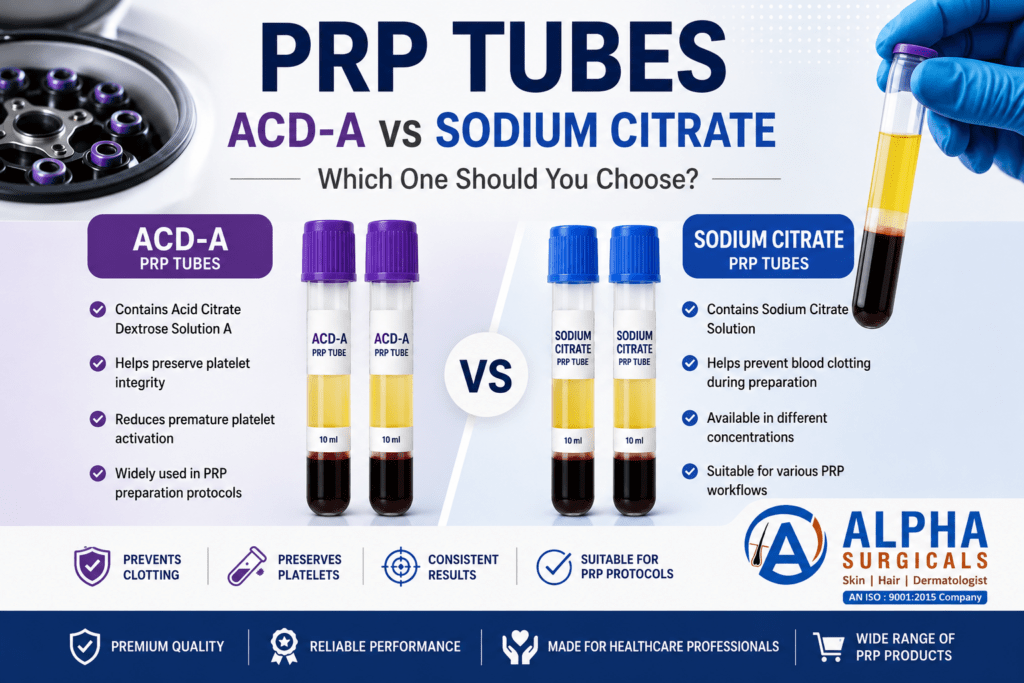
What Is ACD-A?
ACD-A, or Acid Citrate Dextrose Solution A, is a citrate-based anticoagulant commonly used for blood collection and PRP preparation.
ACD-A contains citrate along with dextrose. Citrate helps bind calcium, which is necessary for the coagulation process. By reducing the availability of calcium, ACD-A helps keep collected blood from clotting prematurely.
Furthermore, research and clinical recommendations identify ACD-A as a commonly preferred anticoagulant for PRP preparation, particularly because it helps maintain platelet integrity and reduce unwanted platelet activation during processing.
Potential advantages of ACD-A PRP tubes
- Widely used in PRP preparation
- Helps prevent premature coagulation
- Supports platelet preservation during processing
- Familiar to many PRP practitioners
- Suitable for established PRP preparation protocols
However, the exact characteristics of the final PRP depend on the complete preparation protocol rather than the anticoagulant alone.
What Is Sodium Citrate?
Sodium citrate is another citrate-based anticoagulant used for blood collection and PRP preparation.
Like ACD-A, sodium citrate works primarily by binding calcium and reducing the calcium available for coagulation.
One key difference is that sodium citrate lacks the dextrose component found in ACD-A. Furthermore, sodium citrate formulations come in different concentrations, so healthcare professionals should consider the specific tube formulation and blood-to-anticoagulant ratio.
Potential advantages of sodium citrate PRP tubes
- Commonly used citrate-based anticoagulant
- Helps prevent blood clotting during collection and processing
- Suitable for various laboratory and PRP workflows
- Neutral-pH formulations are available
- Can be selected according to a practitioner’s established protocol
Some studies have also reported lower injection discomfort when clinicians use sodium-citrate-prepared PRP compared with ACD-A in specific facial and scalp PRP applications. However, this finding represents only one clinical outcome and does not establish sodium citrate as universally superior.
ACD-A vs Sodium Citrate PRP Tubes: Key Differences
| Feature | ACD-A | Sodium Citrate |
|---|---|---|
| Anticoagulant type | Citrate + dextrose | Citrate-based |
| Main anticoagulant action | Binds calcium | Binds calcium |
| Common use in PRP | Yes | Yes |
| Helps prevent premature clotting | Yes | Yes |
| Platelet preservation | Supported by several studies | Supported by several studies |
| Contains dextrose | Yes | No |
| Suitable for PRP preparation | Yes | Yes |
| Best choice | Depends on protocol | Depends on protocol |
There is no universal one-size-fits-all answer. Published research reports different findings depending on the PRP preparation method and the outcome being evaluated. Some studies and recommendations favor ACD-A for maintaining platelet integrity and limiting premature activation; however, other research reports favorable platelet recovery and other characteristics with sodium citrate.
So, Which PRP Tube Should You Choose?
The answer depends on your PRP protocol and clinical requirements.
Choose ACD-A when:
- Your established PRP protocol specifies ACD-A.
- You prioritize an anticoagulant widely used in PRP preparation.
- Your workflow has been validated around ACD-A tubes.
- Consistent platelet handling and reduced premature activation are important considerations.
Consider Sodium Citrate when:
- Your established PRP protocol uses sodium citrate.
- You prefer a citrate formulation without dextrose.
- Choose sodium citrate when your specific PRP system is designed and validated for its use.
- Your clinical workflow and intended application support its use.
Instead of choosing a tube based only on the anticoagulant name, healthcare professionals should evaluate the entire PRP preparation system, including tube specifications, blood volume, centrifugation protocol, processing technique, and intended application.
Why the PRP Tube Matters
PRP is not a single standardized product. Different preparation methods can produce PRP with different platelet concentrations, leukocyte content, plasma volumes, and biological characteristics.
The anticoagulant is therefore only one part of the overall process.
A suitable PRP tube should be considered alongside:
- Tube quality and material
- Anticoagulant formulation
- Blood-to-anticoagulant ratio
- Tube volume
- Centrifuge compatibility
- Processing protocol
- Intended PRP application
- Aseptic handling requirements
A standardized workflow can help improve consistency from one PRP preparation to another.
Follow us on Instagram : https://www.instagram.com/alphasurgicals?igsh=cTdjYWNtaXkxazlr
Follow us on Facebook : https://www.facebook.com/alphasurgicals/
Watch and learn suturing techniques : https://alphasurgicals.com/educational-surgical-videos/
Visit our store to purchase other products : https://alphasurgicals.com/store/