
PDO vs PLCL Threads: Key Differences in Aesthetic Treatments
Introduction
Modern aesthetic treatments continue to evolve as practitioners explore minimally invasive approaches to facial rejuvenation and tissue repositioning. Among these options, absorbable thread-based treatments have gained attention for their ability to provide mechanical support while supporting tissue remodeling.
Two materials frequently discussed in aesthetic medicine are Polydioxanone (PDO) and Poly(L-lactide-co-ε-caprolactone) (PLCL). Although both materials are biodegradable and used in absorbable thread applications, they have different chemical compositions, degradation characteristics and mechanical properties.
Understanding PDO vs PLCL Threads helps aesthetic professionals evaluate their material characteristics and potential clinical applications.
At Alpha Surgical, we recognize the importance of understanding surgical materials, instrument quality and evolving technologies in dermatology and aesthetic medicine. Staying informed about these developments supports better professional awareness and product evaluation.
What Are PDO Threads?
PDO stands for Polydioxanone, a synthetic, biodegradable polymer that has a long history of use in absorbable surgical sutures.
In aesthetic medicine, manufacturers produce PDO threads in different configurations, including smooth monofilament threads and barbed or cog threads.
Their applications depend on thread design, placement and the treatment objective.
Key Characteristics of PDO Threads
- Biodegradable material: PDO gradually breaks down through hydrolysis.
- Different configurations: Available designs include smooth, twisted and barbed threads.
- Tissue response: Their presence can stimulate a local tissue-healing response.
- Aesthetic applications: Practitioners use different PDO thread designs for skin rejuvenation and selected tissue-repositioning procedures.
Applications of PDO Threads
PDO threads have several applications in aesthetic medicine:
- Skin rejuvenation using selected smooth-thread designs.
- Fine-line and skin-texture improvement in appropriate cases.
- Mechanical tissue support with suitable barbed-thread designs.
- Selected facial contouring and rejuvenation procedures.
However, not every PDO thread provides a lifting effect. Smooth monofilament threads and barbed suspension threads have different functions.
What Are PLCL Threads?
PLCL stands for Poly(L-lactide-co-ε-caprolactone). It is a biodegradable copolymer made from lactide and caprolactone components.
PLCL has attracted attention in aesthetic medicine because of its physical characteristics, biocompatibility and degradation profile.
Manufacturers use this material in certain absorbable suspension-thread systems designed for soft-tissue repositioning.
Key Characteristics of PLCL Threads
- Biodegradable composition: PLCL gradually degrades within the body.
- Mechanical properties: Its copolymer composition influences flexibility and mechanical behavior.
- Tissue compatibility: Research has examined its biocompatibility and local tissue response.
- Tissue remodeling: Its degradation process and interaction with surrounding tissue may support collagen-related remodeling.
Applications of PLCL Threads
PLCL suspension threads have been studied and used in selected aesthetic applications, including:
- Facial soft-tissue repositioning.
- Improvement of selected signs of facial sagging.
- Facial contouring procedures.
- Rejuvenation treatments involving absorbable suspension threads.
The suitability of PLCL depends on the specific product design, approved indication, patient assessment and practitioner expertise.
PDO vs PLCL Threads: Understanding the Main Differences
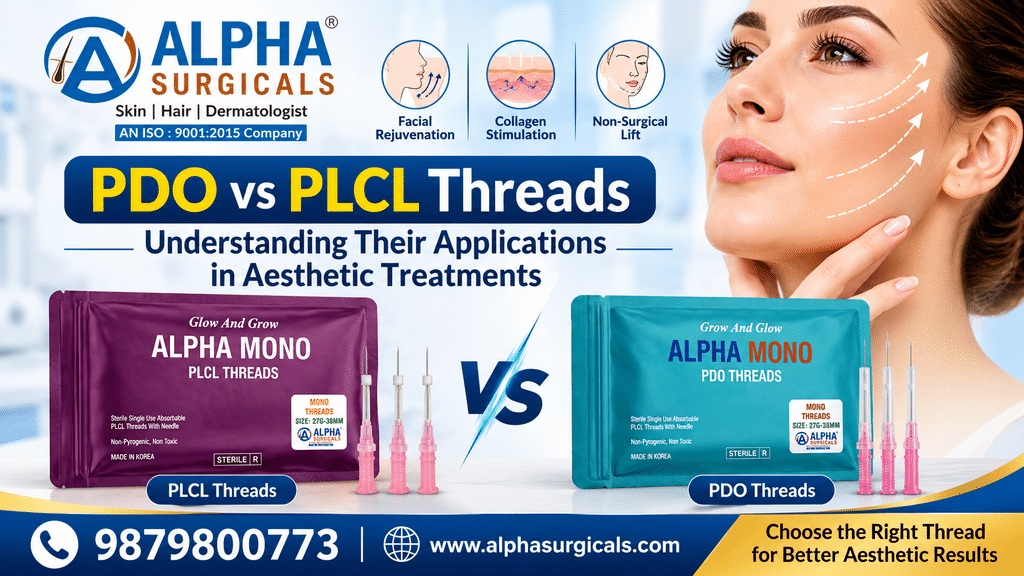
Although PDO and PLCL threads belong to the broader category of absorbable aesthetic materials, they are not interchangeable.
Their chemical composition, mechanical behavior and degradation characteristics differ.
1. Material Composition
PDO consists of polydioxanone, whereas PLCL combines lactide and caprolactone components.
This difference influences the physical properties and degradation behavior of each material.
2. Degradation Characteristics
PDO threads generally degrade faster than PLCL suspension threads.
PLCL materials can have a more prolonged degradation profile. However, the exact absorption period depends on polymer composition, thread dimensions and product formulation.
Therefore, practitioners should always refer to the manufacturer’s product documentation rather than assume a universal absorption timeline.
3. Mechanical Properties
PDO and PLCL can demonstrate different mechanical characteristics.
These include flexibility, elasticity, tensile behavior and resistance to deformation.
Furthermore, the thread’s physical design plays an important role. Smooth threads, barbed threads and other suspension configurations do not provide identical mechanical performance.
4. Tissue Repositioning
PDO and PLCL threads may both have roles in aesthetic procedures, depending on their design.
However, selected PLCL barbed suspension systems are specifically developed for mechanical tissue repositioning.
PDO monofilament threads, in contrast, are commonly associated with skin rejuvenation applications rather than substantial mechanical lifting.
5. Collagen-Related Tissue Response
Both materials can interact with surrounding tissue during degradation.
The resulting tissue response may involve fibroblast activity and collagen remodeling.
However, the available clinical evidence differs between thread materials and product designs. Claims about the duration or extent of collagen stimulation should therefore remain product-specific and evidence-based.
Comparison Table: PDO vs PLCL Threads
| Feature | PDO Threads | PLCL Threads |
|---|---|---|
| Full form | Polydioxanone | Poly(L-lactide-co-ε-caprolactone) |
| Material type | Biodegradable polymer | Biodegradable copolymer |
| Degradation | Generally faster | Generally more prolonged |
| Thread designs | Smooth, twisted and barbed | Product-dependent suspension designs |
| Aesthetic applications | Rejuvenation and selected lifting applications | Selected facial suspension and repositioning applications |
| Tissue response | Local tissue-healing response | Local tissue response and remodeling |
| Clinical considerations | Depends on thread design and indication | Depends on formulation and suspension design |
Note: This comparison describes general material characteristics. It does not establish that one material is universally superior to the other.
Factors to Consider When Evaluating Aesthetic Threads
Choosing an appropriate thread-based system requires more than comparing polymer names.
Aesthetic professionals should consider several factors before selecting a product.
1. Material Quality
The polymer composition and manufacturing quality influence the thread’s physical characteristics and consistency.
2. Thread Design
Smooth, twisted and barbed configurations serve different purposes. Consequently, practitioners should evaluate the design according to the intended clinical application.
3. Mechanical Performance
Tensile strength, flexibility and structural integrity are important characteristics when evaluating suspension-thread products.
4. Biocompatibility
The material should have appropriate biocompatibility documentation and product-specific safety information.
5. Manufacturer Documentation
Product specifications, regulatory status, sterilization information and instructions for use should be reviewed before clinical consideration.
Safety and Clinical Considerations
PDO and PLCL thread procedures are minimally invasive, but they are not risk-free.
Potential complications include:
- Swelling and bruising.
- Temporary discomfort.
- Skin dimpling or irregularities.
- Infection.
- Thread visibility or palpability.
- Asymmetry or unsatisfactory cosmetic results.
- Thread migration or extrusion.
Appropriate patient selection, anatomical knowledge, sterile clinical practices and professional training remain essential.
Moreover, practitioners should explain realistic treatment expectations and discuss possible complications before any procedure.
How Alpha Surgical Supports Dermatology and Aesthetic Professionals
Modern aesthetic medicine requires continuous learning, dependable surgical products and an understanding of evolving clinical technologies.
Alpha Surgical focuses on professional medical and surgical products for dermatology, aesthetic medicine and hair restoration applications.
Our commitment centers on:
- Supporting professional dermatology and aesthetic practices.
- Providing surgical and dermatology-related product solutions.
- Emphasizing product quality and practical clinical requirements.
- Keeping pace with developments in minimally invasive procedures.
- Supporting awareness of modern surgical instruments and technologies.
Whether professionals are exploring thread-based treatments or other aesthetic procedures, understanding material properties and product specifications remains an important part of clinical decision-making.
Visit Alpha Surgical to explore our range of professional surgical and dermatology-related products.
Conclusion
Understanding PDO vs PLCL Threads requires evaluating their composition, mechanical properties, degradation behavior and intended applications.
PDO offers a well-established absorbable polymer with several thread configurations for aesthetic applications. PLCL, on the other hand, is a biodegradable copolymer used in selected suspension-thread systems, particularly those designed for facial tissue repositioning.
Ultimately, neither material is universally better. The appropriate choice depends on the specific product, treatment objective, patient characteristics and practitioner assessment.
At Alpha Surgical, we believe that knowledge of evolving aesthetic technologies and dependable surgical products contributes to informed professional practice.
Frequently Asked Questions (FAQs)
1. What is the main difference between PDO and PLCL threads?
PDO is a polydioxanone polymer, whereas PLCL is a copolymer of lactide and caprolactone. They differ in composition, degradation characteristics and mechanical properties.
2. Are PDO and PLCL threads absorbable?
Yes. Both materials are biodegradable and can gradually break down within the body. Their degradation timelines vary according to material composition and product formulation.
3. Are PLCL threads used for facial lifting?
Certain PLCL barbed suspension-thread systems are designed for facial soft-tissue repositioning. Their suitability depends on the specific product and clinical indication.
4. Do PDO threads stimulate collagen?
PDO threads can produce a local tissue response associated with collagen remodeling. However, the extent of this response depends on thread design and other clinical factors.
5. Do PLCL threads last longer than PDO threads?
PLCL generally has a more prolonged degradation profile than PDO. Nevertheless, the actual duration depends on the specific formulation and manufactured thread.
6. Are PDO and PLCL threads suitable for every patient?
No. A qualified medical professional must assess individual anatomy, treatment goals, medical history and possible contraindications before considering a thread-based procedure.
7. What should practitioners consider when evaluating absorbable threads?
Important considerations include material composition, thread design, mechanical properties, biocompatibility, manufacturer documentation, regulatory status and clinical evidence.
Connect With Alpha Surgical
Explore professional surgical and dermatology-related product solutions with Alpha Surgical.
For product enquiries and further information:
Call: 9879800773
Follow us on Instagram : https://www.instagram.com/alphasurgicals?igsh=cTdjYWNtaXkxazlr
Follow us on Facebook : https://www.facebook.com/alphasurgicals/
Watch and learn suturing techniques : https://alphasurgicals.com/educational-surgical-videos
Visit our store to purchase other products : https://alphasurgicals.com/store