
What Is Microneedling vs PRP?
Microneedling vs PRP compares two popular approaches used in dermatology and aesthetic medicine. Although both treatments can support skin rejuvenation, they work through different mechanisms.
Microneedling uses fine needles to create controlled micro-injuries in the skin. This process stimulates the skin’s natural repair response and can support collagen and elastin production.
PRP (Platelet-Rich Plasma) uses a concentrated portion of the patient’s own blood that contains platelets and plasma. Platelets contain growth factors and signaling molecules that may support tissue repair and regeneration.
Therefore, healthcare professionals may use these treatments separately or combine them according to the patient’s condition and treatment goals.
How Does Microneedling Work?
During microneedling, a healthcare professional uses a device containing fine needles to create controlled microchannels in the skin.
The skin then activates its natural healing response. As a result, collagen and elastin production can increase over time.
Microneedling may be used in professional dermatology and aesthetic procedures for concerns such as:
- Uneven skin texture
- Certain acne scars
- Fine lines
- Enlarged pores
- Overall skin rejuvenation
The appropriate device, needle depth, and treatment protocol depend on the treatment area and the individual’s skin condition.
What Is PRP Therapy?
PRP stands for Platelet-Rich Plasma.
During PRP preparation, healthcare professionals collect a patient’s blood and process it to obtain a plasma fraction with a higher platelet concentration.
Platelets contain naturally occurring growth factors and signaling molecules. Consequently, researchers have studied PRP for applications involving tissue repair, skin rejuvenation, and hair restoration.
However, PRP preparation methods can vary. Factors such as collection tubes, anticoagulant formulation, centrifugation protocol, and processing technique can influence the final preparation.
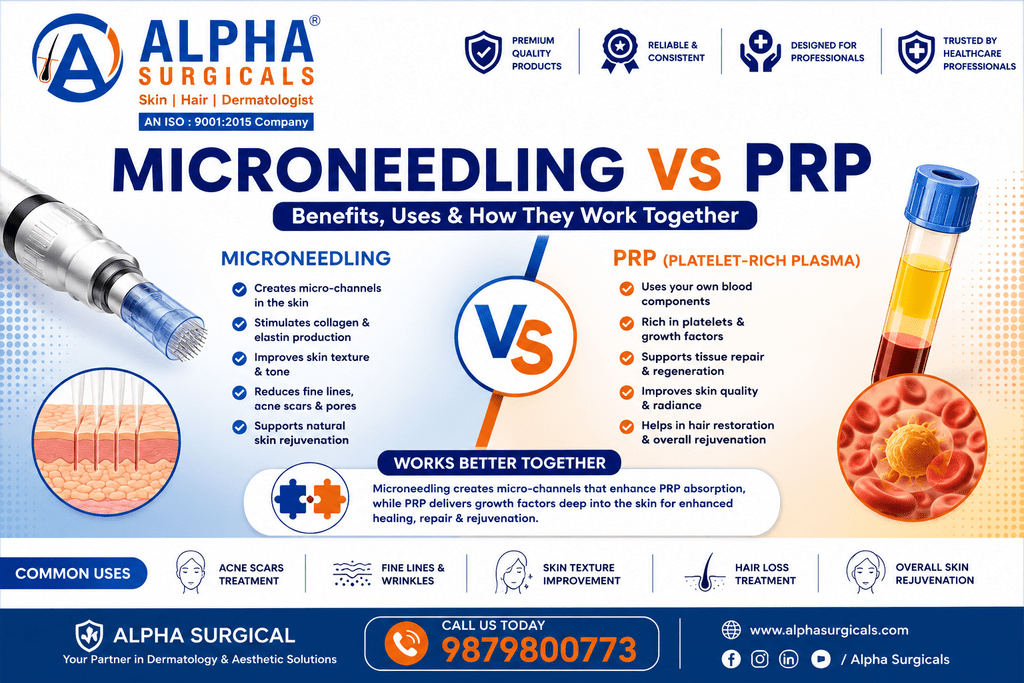
Microneedling vs PRP: Key Differences
| Feature | Microneedling | PRP |
|---|---|---|
| Main approach | Creates controlled microchannels | Uses concentrated blood components |
| Primary mechanism | Stimulates natural skin repair | Delivers platelet-rich plasma |
| Main focus | Collagen and skin remodeling | Growth factors and tissue signaling |
| Source | Uses a microneedling device | Uses the patient’s own blood |
| Common applications | Texture, scars, rejuvenation | Skin and hair restoration applications |
| Preparation | No blood preparation required | Requires blood collection and processing |
Therefore, these treatments are not identical. Each approach has its own mechanism and clinical considerations.
Microneedling Benefits
Microneedling can offer several potential benefits when performed appropriately by a qualified professional.
- Supports collagen production
- May improve overall skin texture
- Can be used for selected acne scars
- May reduce the appearance of fine lines
- Supports skin rejuvenation
Results can vary depending on skin condition, treatment settings, treatment frequency, and individual response.
PRP Benefits
PRP offers a different approach because it uses components obtained from the patient’s own blood.
Potential benefits include:
- Autologous treatment approach
- Platelet-derived growth factors
- Applications in skin rejuvenation
- Applications in hair restoration
- Compatibility with different clinical protocols
Importantly, PRP preparation systems can produce different platelet and plasma characteristics. Therefore, healthcare professionals should follow the specific product and processing protocol.
How Can Microneedling and PRP Work Together?
Healthcare professionals may combine microneedling and PRP as part of selected skin-rejuvenation protocols.
Microneedling creates controlled microchannels in the skin, while PRP provides a platelet-rich preparation containing growth factors and signaling molecules.
Consequently, some practitioners use PRP alongside microneedling to support a combined treatment approach.
However, the combination does not guarantee better results for every patient. Treatment selection should depend on the individual’s skin condition, goals, medical history, and professional assessment.
Microneedling vs PRP: Which Is Better?
There is no universal answer.
Microneedling and PRP address skin concerns through different mechanisms. Therefore, the more appropriate option depends on factors such as:
- Treatment objective
- Skin condition
- Type of scarring
- Treatment area
- Patient suitability
- Professional experience
- Established clinical protocol
In some cases, healthcare professionals may recommend one approach. In others, they may consider combining both.
What Should Healthcare Professionals Consider?
Before selecting a treatment, professionals should consider:
Treatment Goal
Determine whether the primary goal involves skin texture, scarring, rejuvenation, hair restoration, or another application.
Patient Suitability
Assess the patient’s skin condition and overall suitability for the planned procedure.
Equipment and Products
Use appropriate professional-grade devices and PRP collection and processing systems.
Treatment Protocol
Follow an established protocol and the manufacturer’s instructions for relevant devices and products.
Alpha Surgical – Supporting Dermatology & PRP Professionals
Alpha Surgical provides professional medical and surgical products for healthcare applications, including products associated with PRP preparation, dermatology, aesthetic procedures, and hair restoration.
Our focus remains on quality, reliability, and professional requirements. We aim to support healthcare professionals with dependable products for their established clinical workflows.
Whether professionals are looking for PRP-related products or other dermatology and surgical supplies, Alpha Surgical offers solutions designed for professional applications.
Frequently Asked Questions
What is the difference between microneedling and PRP?
Microneedling creates controlled microchannels in the skin to stimulate the natural repair process, while PRP uses a concentrated blood-derived preparation containing platelets and growth factors.
Can microneedling and PRP be used together?
Yes. Healthcare professionals may combine the two approaches in selected treatment protocols. However, suitability depends on the patient’s condition and professional assessment.
Is PRP better than microneedling?
Neither treatment is universally better. They work through different mechanisms, so the appropriate option depends on the treatment objective and individual circumstances.
What is PRP used for?
Professionals may use PRP in applications such as skin rejuvenation and hair restoration. Specific applications depend on the clinical protocol and professional assessment.
Does microneedling stimulate collagen?
Microneedling creates controlled micro-injuries that stimulate the skin’s natural healing response, which can promote collagen remodeling.
Final Takeaway
Microneedling vs PRP represents a comparison between two different approaches to professional skin and regenerative treatments.
Microneedling works by creating controlled microchannels that stimulate the skin’s repair response, while PRP provides a platelet-rich preparation containing naturally occurring growth factors and signaling molecules.
Furthermore, healthcare professionals may combine both approaches in selected protocols. However, treatment decisions should always consider the patient’s condition, treatment goals, and established clinical practice.
Alpha Surgical remains committed to supporting healthcare professionals with quality medical, dermatology, aesthetic, and PRP-related products.
Follow us on Instagram : https://www.instagram.com/alphasurgicals?igsh=cTdjYWNtaXkxazlr
Follow us on Facebook : https://www.facebook.com/alphasurgicals/
Watch and learn suturing techniques : https://alphasurgicals.com/educational-surgical-videos/
Visit our store to purchase other products : https://alphasurgicals.com/store/