
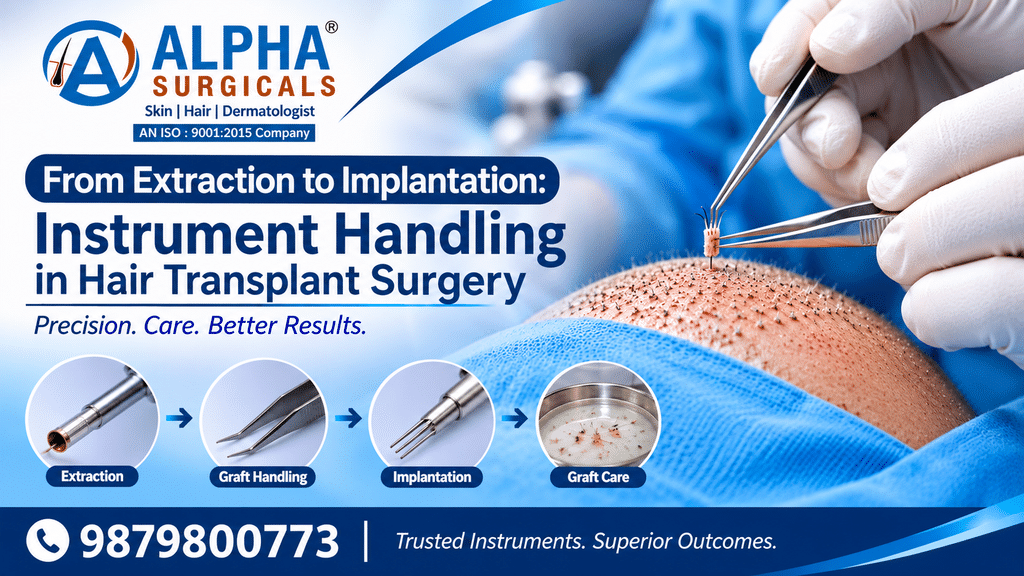
Hair transplant surgery requires precision, consistency and careful instrument management at every stage. From follicular unit extraction (FUE) to graft preparation and implantation, each instrument plays an important role in supporting the surgical workflow.
However, even high-quality surgical instruments require appropriate handling and maintenance. Incorrect instrument selection, inconsistent cleaning and poor coordination can affect procedural efficiency and graft management.
Therefore, hair transplant instrument handling deserves special attention in modern hair restoration practices.
Understanding Hair Transplant Instrument Handling
Hair transplant instrument handling involves selecting, using, inspecting and maintaining surgical instruments throughout the transplantation process.
Each stage requires instruments designed for a particular purpose.
For example:
- FUE punches support follicular unit extraction.
- Forceps assist with graft handling.
- Graft storage solutions support appropriate graft preservation.
- Implanter pens support graft placement in selected implantation techniques.
Consequently, professionals must understand the purpose and characteristics of each instrument before selecting it for clinical use.
Common Instrument Handling Mistakes in Hair Transplant Surgery
Understanding common mistakes helps surgical teams improve instrument management and maintain a consistent workflow.
1. Using the Wrong Instrument for the Procedure
Every surgical instrument serves a specific purpose. Using an unsuitable instrument can affect handling consistency and workflow efficiency.
For example, FUE punches, forceps and implanter pens have different applications. Therefore, professionals should select instruments according to the procedure, clinical requirements and manufacturer recommendations.
2. Ignoring Instrument Maintenance
Regular instrument maintenance plays an important role in maintaining product quality.
However, some teams may overlook routine inspection, cleaning and sterilization requirements.
Over time, inadequate maintenance can affect instrument condition and reliability. Therefore, healthcare professionals should follow approved reprocessing protocols and manufacturer instructions.
3. Improper Forceps Handling
Forceps play an important role in hair graft management. Inconsistent handling or unsuitable forceps selection may increase unnecessary graft manipulation.
Moreover, instrument design, tip characteristics and handling comfort can influence the user’s control.
For this reason, professionals should select suitable forceps and follow established clinical practices.
4. Overlooking FUE Punch Quality
FUE punches are essential instruments in follicular unit extraction.
Their edge geometry, dimensions, material quality and overall design influence instrument performance and tissue interaction.
Nevertheless, selecting an appropriate punch requires consideration of the clinical application and individual patient requirements.
Professionals should also inspect instruments regularly and follow the manufacturer’s recommendations.
5. Poor Coordination Between Extraction and Implantation
Hair transplantation involves several interconnected stages. Therefore, effective coordination between extraction, graft preparation and implantation helps maintain an organized workflow.
Poor communication or inadequate instrument preparation can create unnecessary delays.
Instead, organized instrument arrangements, clear team communication and appropriate preparation can support procedural continuity.
6. Neglecting Implanter Pen Maintenance
Implanter pens support graft placement in selected hair transplantation techniques.
However, professionals should not overlook their maintenance, compatibility and inspection requirements.
Regular checks and appropriate cleaning according to manufacturer instructions help maintain instrument condition and support reliable performance.
Why Proper Hair Transplant Instrument Handling Matters
Proper hair transplant instrument handling supports several important aspects of the surgical workflow.
1. Instrument consistency
Appropriate selection and maintenance help professionals work with instruments that meet their clinical requirements.
2. Graft management
Suitable instruments and careful handling support organized graft transfer and preservation.
3. Workflow efficiency
Proper preparation helps teams coordinate extraction, graft preparation and implantation more effectively.
4. Instrument reliability
Regular inspection and maintenance help preserve instrument quality.
5. Professional confidence
Reliable instruments and ergonomic designs can support comfortable and consistent instrument handling.
Ultimately, instrument quality and professional expertise work together to support a well-managed surgical procedure.
The Importance of Graft Handling From Extraction to Implantation
Graft management is an important part of hair transplantation. After extraction, teams must handle and manage grafts according to established clinical protocols until implantation.
During this process, professionals should consider:
- Appropriate instrument selection.
- Careful graft transfer.
- Suitable storage conditions.
- Timely coordination between procedural stages.
- Compliance with established clinical protocols.
Furthermore, appropriate graft storage solutions and reliable instruments help support an organized graft management process.
How Alpha Surgical Supports Hair Transplant Professionals
Alpha Surgical supplies professional medical and surgical instruments for dermatology, aesthetic medicine and hair restoration applications.
The company focuses on quality, reliability and practical clinical requirements.
Its hair restoration instrument range supports different stages of hair transplantation, including extraction, graft handling and implantation.
Alpha Surgical focuses on providing instruments such as:
- FUE punches for follicular unit extraction.
- Hair transplant forceps for graft handling.
- Implanter pens for selected implantation techniques.
- Supporting surgical instruments and accessories.
Moreover, instrument design, material quality and practical usability remain important considerations when selecting products for professional applications.
Through its product range, Alpha Surgical aims to support healthcare professionals with instruments suited to modern clinical requirements.
What to Consider When Selecting Hair Transplant Instruments
Before choosing hair transplant instruments, professionals should evaluate several important factors.
Instrument design: Select instruments that suit the intended clinical application.
Material quality: Consider durability, finish and compatibility with approved cleaning and sterilization methods.
Precision: Evaluate instrument consistency and suitability for the procedure.
Ergonomics: Consider handling comfort, balance and ease of use.
Maintenance: Follow the manufacturer’s instructions for cleaning, sterilization and inspection.
Clinical requirements: Choose instruments according to professional judgment and individual procedural needs.
These factors help professionals make informed decisions when selecting surgical instruments.
Conclusion
From extraction to implantation, hair transplant instrument handling remains an important part of modern hair restoration procedures.
Avoiding common handling mistakes, selecting appropriate instruments and maintaining product quality can support better workflow management and graft care.
With a focus on precision, quality and reliability, Alpha Surgical continues to support professionals in dermatology, aesthetics and hair transplantation.
Alpha Surgical – Trusted Instruments for Professional Surgical Practice.
Frequently Asked Questions
1. What is hair transplant instrument handling?
Hair transplant instrument handling involves selecting, using, inspecting and maintaining surgical instruments throughout extraction, graft preparation and implantation.
2. Which instruments are commonly used in hair transplant surgery?
Common instruments include FUE punches, extraction tools, forceps, graft storage solutions and implanter pens. Their selection depends on the surgical technique and clinical requirements.
3. What are the common instrument handling mistakes in hair transplantation?
Common mistakes include incorrect instrument selection, inadequate maintenance, improper forceps handling, overlooking FUE punch quality and poor coordination between extraction and implantation.
4. Why is FUE punch quality important?
FUE punch design and edge characteristics influence instrument performance and tissue interaction. Professionals should select suitable instruments based on clinical requirements.
5. Why is instrument maintenance important?
Regular inspection, cleaning, sterilization and maintenance help preserve instrument condition and support reliable performance.
6. How do implanter pens support hair transplantation?
Implanter pens support graft placement in selected hair transplantation techniques. Their selection depends on the procedure and professional requirements.
7. How can professionals contact Alpha Surgical?
Professionals can contact Alpha Surgical at 9879800773 to learn more about its medical and surgical instrument range.
Explore Alpha Surgical Products
Looking for professional instruments for hair transplantation, dermatology and aesthetic procedures?
Explore the product range at Alpha Surgical.
Contact Number: 9879800773
Follow us on Instagram : https://www.instagram.com/alphasurgicals?igsh=cTdjYWNtaXkxazlr
Follow us on Facebook : https://www.facebook.com/alphasurgicals/
Watch and learn suturing techniques : https://alphasurgicals.com/educational-surgical-videos/
Visit our store to purchase other products : https://alphasurgicals.com/store/