
Why Hairline Design Matters Before Hair Transplant Surgery: Tools and Techniques
A successful hair transplant involves much more than simply restoring lost hair. In fact, it also requires careful planning to create a natural-looking hairline that complements the patient’s facial features, age, hair characteristics, and long-term hair growth pattern.
Hairline Design Before Hair Transplant Surgery is, therefore, one of the most important steps in the hair restoration process. Moreover, a well-planned hairline helps establish the overall appearance of the transplant, determines where grafts should be placed, and supports a balanced, natural-looking result.
Furthermore, modern hair restoration specialists use advanced measurement tools, scalp assessments, digital imaging, and precise surgical techniques to plan the hairline. As a result, they can evaluate individual requirements and make more informed decisions before beginning the procedure.
At Alpha Surgical, we understand the importance of precision, proper planning, and reliable medical equipment in modern surgical environments. In this article, we will explore why hairline design matters, which tools specialists commonly use, and how different techniques contribute to effective hair transplant planning.
Today, hair restoration specialists use advanced measurement tools, scalp assessments, digital imaging, and precise surgical techniques to plan the hairline. These methods help surgeons make informed decisions before beginning the procedure.
At Alpha Surgical, we understand the importance of precision, proper planning, and reliable medical equipment in modern surgical environments. This guide explores the importance of hairline design, the tools involved, and the techniques that support effective hair transplant planning.
1. What Is Hairline Design Before Hair Transplant Surgery?
Hairline design is the process of determining the position, shape, direction, and density of the hairline before a hair transplant procedure.
During consultation, the hair restoration surgeon examines the patient’s forehead, facial structure, existing hair, scalp condition, and donor area. Based on this assessment, the surgeon creates a proposed hairline that complements the patient’s natural appearance.
The design usually considers:
- Forehead height and facial proportions.
- Existing hairline and hair loss pattern.
- Natural hair growth direction.
- Hair thickness, texture, and density.
- Age and potential future hair loss.
- Availability and quality of donor hair.
- Patient expectations and personal preferences.
Rather than creating an artificially straight or excessively low hairline, the surgeon aims for a design that looks appropriate for the individual’s facial features and long-term hair restoration goals.
2. Why Does Hairline Design Matter Before Hair Transplant Surgery?
The hairline frames the face. Even a technically successful hair transplant can look unnatural if the hairline has an unsuitable position, shape, or direction.
Here are the major reasons why careful hairline planning matters.
A. Creates a Natural Appearance
A natural hairline rarely looks like a perfectly straight line. It usually contains subtle irregularities, fine transitional hairs, and variations in density.
Therefore, surgeons carefully plan the frontal edge to create a soft transition between the forehead and transplanted hair.
B. Maintains Facial Proportions
Every individual has different facial proportions. A hairline that looks appropriate on one person may not suit another.
Surgeons evaluate the forehead, eyebrows, temples, and overall facial structure before deciding where the new hairline should begin.
For example, a hairline placed too low may create an unbalanced appearance. Similarly, a hairline placed too high may not provide the desired facial framing.
C. Supports Long-Term Hair Restoration
Hair loss can continue even after a transplant. Therefore, surgeons should consider the possibility of future thinning when designing the initial hairline.
An excessively low or dense hairline may use a significant amount of the available donor hair. This can limit future treatment options if hair loss progresses.
A conservative, well-planned design helps balance current cosmetic goals with possible future requirements.
D. Improves Graft Placement Planning
Hairline design also helps determine the number and distribution of grafts required for the recipient area.
Surgeons assess the existing hair and plan graft placement according to the desired coverage and density.
This planning helps avoid unnecessary graft usage and supports a more balanced distribution of available donor hair.
3. Essential Tools Used for Hairline Design
Modern hair transplant planning involves several tools that help specialists assess the scalp, measure proportions, and mark the proposed hairline.
The following tools are commonly used during preoperative assessment and planning.
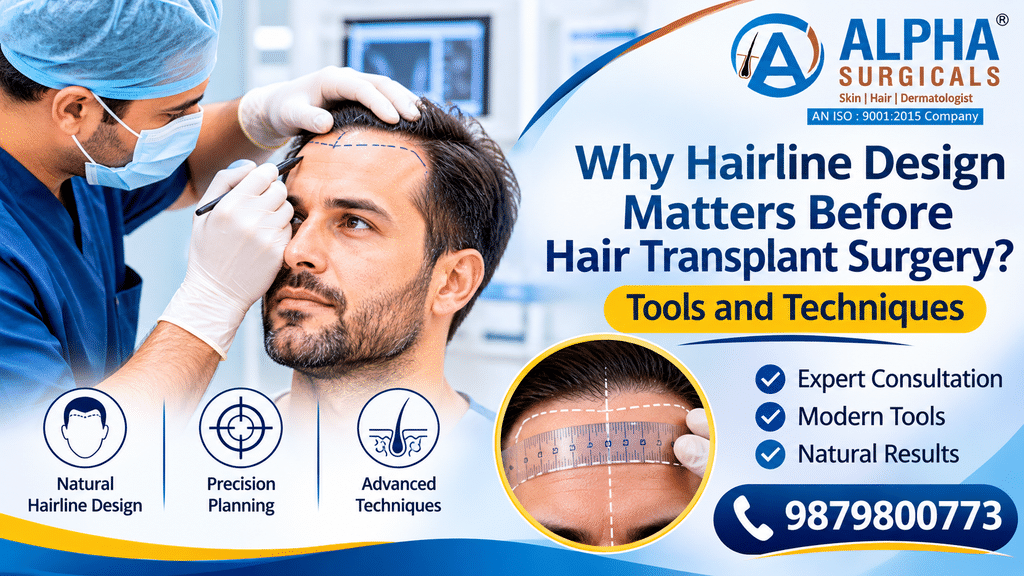
A. Hairline Measuring Scale and Ruler
A measuring scale or specialized hairline ruler helps the surgeon assess forehead dimensions and mark reference points.
These measurements support consistent planning and help compare the proposed hairline with the patient’s facial proportions.
Key benefits:
- Helps establish measurement reference points.
- Supports symmetrical planning.
- Assists with forehead measurements.
- Helps document the proposed hairline.
B. Surgical Skin Marker
A medical-grade surgical skin marker helps the surgeon draw the proposed hairline directly on the scalp.
The surgeon can mark the frontal edge, temporal regions, and important reference points before surgery.
This allows the patient and surgeon to review the design together and discuss any adjustments.
Key benefits:
- Provides visible surgical reference lines.
- Helps communicate the proposed design.
- Supports accurate preoperative marking.
- Makes final planning easier to review.
C. Digital Imaging and Photography
Digital photography helps document the patient’s existing hairline and scalp condition.
Clinics may capture photographs from different angles, including the front, sides, and top of the head.
Digital images can also support before-and-after comparisons and treatment documentation.
Key benefits:
- Records the original hairline.
- Supports consultation and planning.
- Helps document treatment progress.
- Allows comparison from multiple angles.
D. Trichoscopy and Scalp Analysis Tools
Trichoscopy uses magnification to examine the scalp and hair follicles.
It helps specialists evaluate hair density, hair shaft characteristics, follicular changes, and signs of miniaturization.
These findings can help determine whether the patient is a suitable candidate for transplantation and support more informed planning.
E. Magnification and Graft Inspection Equipment
Magnification tools and surgical microscopes help trained surgical teams examine follicular units during graft preparation.
They can assist with identifying individual follicular units and preserving delicate graft structures during handling.
Proper graft inspection is especially important when creating a natural-looking frontal hairline.
4. Popular Hairline Design Techniques
Hairline design is not a one-size-fits-all process. Surgeons select an approach based on facial structure, hair characteristics, donor availability, and individual treatment goals.
Here are some important techniques used in hair restoration planning.
A. Facial Proportion Assessment
Facial proportion assessment helps the surgeon evaluate how the proposed hairline relates to the forehead and other facial features.
Some specialists use the facial rule of thirds as a general reference. However, this is not a universal measurement formula. Individual anatomy and natural hairline characteristics remain important.
B. Soft and Irregular Hairline Design
A natural frontal hairline usually contains subtle irregularities rather than a perfectly straight edge.
Surgeons may plan small variations along the frontal border to avoid an artificial appearance.
This technique helps create a gradual transition between the forehead and the transplanted hair.
C. Single-Hair Graft Placement
Follicular units may contain one or more hairs.
Surgeons commonly prioritize finer, single-hair follicular units along the leading edge of the hairline. Larger follicular units may be placed behind this transitional zone, depending on the patient’s characteristics and surgical plan.
This arrangement helps create a softer frontal appearance.
D. Hair Growth Direction and Angulation
Natural hair does not grow straight upward across the entire scalp.
The direction and angle of growth change across the frontal hairline, temples, and other scalp regions.
Surgeons carefully consider these patterns when creating recipient sites and placing grafts.
Correct direction and angulation help the transplanted hair blend with surrounding hair and remain easier to style.
E. Temple and Corner Design
The temples and frontal corners contribute significantly to the overall hairline appearance.
An unsuitable temple shape can make an otherwise successful transplant look unnatural.
Therefore, surgeons evaluate temple recession, facial proportions, and natural hair growth patterns when planning these areas.
5. How FUE and FUT Techniques Affect Hairline Planning
Follicular Unit Extraction (FUE) and Follicular Unit Transplantation (FUT) are two established hair transplantation techniques.
Both methods require careful hairline planning, although their donor-hair harvesting approaches differ.
FUE (Follicular Unit Extraction)
FUE involves removing individual follicular units from the donor area using specialized extraction instruments.
The surgeon then prepares the grafts for placement in the recipient area.
Important considerations:
- Individual follicular unit extraction.
- Careful donor-area management.
- Graft selection and preparation.
- Accurate recipient-site planning.
- Natural hair direction and angulation.
FUT (Follicular Unit Transplantation)
FUT involves removing a strip of hair-bearing scalp from the donor area. The surgical team then separates the tissue into follicular unit grafts under magnification.
Important considerations:
- Proper donor-strip planning.
- Careful follicular unit dissection.
- Graft inspection and preparation.
- Recipient-area design.
- Natural-looking hairline placement.
Both techniques can support natural-looking results when specialists select the appropriate method and perform the procedure carefully.
6. Common Hairline Design Mistakes to Avoid
Poor planning can affect the appearance of a hair transplant, even when grafts grow successfully.
Surgeons should pay attention to the following common mistakes.
1. Creating an excessively low hairline
A very low hairline may look appealing initially but can become unsuitable as the patient ages or experiences further hair loss.
2. Designing a perfectly straight hairline
A completely straight frontal edge may appear artificial because natural hairlines generally have subtle variations.
3. Ignoring facial proportions
A hairline should complement the individual’s facial structure rather than follow a fixed template.
4. Overlooking future hair loss
Surgeons should consider the possibility of progressive hair loss and preserve sufficient donor hair for potential future needs.
5. Incorrect hair direction
Grafts placed at unsuitable angles or in the wrong direction may create an unnatural appearance.
6. Using unsuitable grafts along the frontal edge
Larger follicular units at the leading edge can create an abrupt transition. Graft selection should reflect the desired natural appearance.
7. Ignoring patient expectations
Patients should understand the proposed design before surgery. Clear communication between the patient and surgeon helps establish realistic expectations.
7. The Role of Precision Medical Equipment in Hair Transplant Surgery
Precision medical equipment plays an important role in modern surgical environments.
Hair restoration procedures require specialized instruments for assessment, graft extraction, graft preparation, and implantation.
The quality, suitability, maintenance, and sterilization of surgical equipment can support an organized and controlled clinical workflow.
Important equipment considerations include:
- Appropriate surgical instruments.
- Accurate measuring and marking tools.
- Magnification equipment.
- Graft handling instruments.
- Proper sterilization facilities.
- Safe storage and equipment maintenance.
Alpha Surgical recognizes the importance of quality medical equipment and precision in professional surgical environments.
For clinics and healthcare professionals looking for medical and surgical equipment, Alpha Surgical aims to support informed equipment selection based on clinical requirements.
Choosing suitable equipment should always involve consideration of its intended use, manufacturer instructions, applicable standards, and the requirements of qualified medical professionals.
8. What Should Patients Discuss Before Finalizing Their Hairline?
Before proceeding with hair transplant surgery, patients should have a detailed discussion with their qualified hair restoration surgeon.
Consider asking these questions:
- Does the proposed hairline suit my facial structure?
- Is the design appropriate for my age?
- How might future hair loss affect the result?
- How many grafts will the planned hairline require?
- Is my donor area sufficient?
- Which transplantation technique is appropriate for me?
- How will the surgeon recreate natural hair direction?
- What results can I realistically expect?
- Will I need medical treatment to manage ongoing hair loss?
A detailed consultation helps patients understand the procedure, its limitations, and the long-term treatment plan.
9. Why Choose Alpha Surgical for Medical and Surgical Equipment?
Modern healthcare environments depend on appropriate medical equipment, reliable instruments, and careful product selection.
At Alpha Surgical, we recognize that healthcare professionals need equipment suited to their clinical applications and workflow requirements.
We focus on the importance of:
- Quality-conscious medical equipment selection.
- Professional healthcare requirements.
- Precision-focused surgical environments.
- Reliable product information.
- Customer assistance and enquiries.
Whether you are exploring medical equipment requirements or looking for suitable surgical instruments, contact Alpha Surgical to discuss your requirements.
Contact Alpha Surgical: 9879800773
Conclusion: Plan the Hairline Before Planning the Transplant
Hairline design is a fundamental part of hair transplant planning. It influences facial framing, graft distribution, hair direction, and the overall appearance of the final result.
By considering facial proportions, future hair loss, donor availability, and natural growth patterns, qualified surgeons can develop a more suitable treatment plan for each patient.
Modern tools such as measuring scales, surgical skin markers, digital imaging, scalp analysis equipment, and magnification systems support accurate assessment and preparation.
At Alpha Surgical, we believe that precision and appropriate medical equipment are important elements of professional healthcare environments.
For medical and surgical equipment enquiries, contact us today.
Alpha Surgical
Call: 9879800773
Frequently Asked Questions (FAQs)
1. Why is hairline design important before hair transplant surgery?
Hairline design determines the position, shape, and direction of transplanted hair. Proper planning helps create a natural-looking appearance while considering facial proportions and future hair loss.
2. Which tools are used for hairline design?
Commonly used tools include hairline measuring scales, medical-grade surgical skin markers, digital photography systems, trichoscopy equipment, and magnification tools.
3. How do surgeons determine the correct hairline?
Surgeons evaluate facial proportions, forehead dimensions, existing hair growth, donor availability, age, and potential future hair loss before proposing a hairline.
4. Can a hair transplant create a completely straight hairline?
A straight hairline is not always the most natural option. Surgeons generally consider subtle irregularities and individual hair growth patterns to create a more natural appearance.
5. What is the difference between FUE and FUT?
FUE removes individual follicular units from the donor area, whereas FUT removes a strip of hair-bearing scalp that is divided into individual grafts. Both techniques require careful hairline planning.
6. Does hairline design affect the number of grafts required?
Yes. The position, shape, coverage area, and desired density of the hairline influence graft requirements. The surgeon must also consider available donor hair.
7. Can a hairline change as a person gets older?
Yes. Natural hair loss can progress with age. Therefore, surgeons should consider potential future hair loss when designing a hairline.
8. Who should perform hairline design before surgery?
A qualified and appropriately trained hair restoration physician should assess the patient, plan the surgical hairline, and oversee the surgical procedure.
9. Can digital imaging help with hair transplant planning?
Yes. Digital photographs and imaging tools can document the existing hairline, support consultation, and help compare treatment progress. However, they do not replace clinical assessment.
10. How can I contact Alpha Surgical?
For medical and surgical equipment enquiries, contact Alpha Surgical at 9879800773.
Follow us on Instagram : https://www.instagram.com/alphasurgicals?igsh=cTdjYWNtaXkxazlr
Follow us on Facebook : https://www.facebook.com/alphasurgicals/
Watch and learn suturing techniques : https://alphasurgicals.com/educational-surgical-videos/
Visit our store to purchase other products : https://alphasurgicals.com/store/