
Hair transplantation involves more than extracting and implanting hair follicles. Between these two stages, hair graft preservation plays an important role in maintaining graft quality and supporting the overall transplantation process.
Each extracted graft contains delicate follicular structures that require careful handling. Therefore, the surgical team must pay attention to storage conditions, hydration, temperature, handling, and the time spent outside the body.
At Alpha Surgical, we understand the importance of suitable instruments and accessories in professional hair restoration. Our range of hair transplant products supports healthcare professionals who require practical tools for different stages of their procedures.
In this article, we explore the science behind hair graft preservation, explain what happens between extraction and implantation, and discuss how appropriate instruments can support careful graft handling.
What Is Hair Graft Preservation?
Hair graft preservation refers to the measures used to protect extracted follicular units before the surgeon implants them into the recipient area.
During hair transplantation, professionals remove grafts from a donor area and prepare them for placement. However, these grafts are delicate living tissues, and their condition can change while they remain outside the body.
For this reason, the surgical team must handle grafts carefully and follow an appropriate preservation protocol.
Effective hair graft preservation focuses on several important factors:
- Maintaining suitable hydration
- Following the recommended storage temperature
- Minimizing unnecessary handling and mechanical stress
- Using an appropriate preservation medium
- Managing the time between extraction and implantation
- Monitoring graft condition throughout the process
Together, these measures help the clinical team protect graft integrity during the transplantation workflow.
Why Does Hair Graft Preservation Matter?
Hair follicles contain living cells that depend on suitable conditions to remain viable. Once a graft leaves the body, it no longer receives oxygen and nutrients through its original blood supply.
Consequently, the team must pay close attention to how it handles and stores the graft until implantation.
1. Maintaining Graft Viability
Graft viability refers to the ability of the follicular tissue to remain alive and functional. The storage environment can influence this viability.
Appropriate preservation protocols help limit avoidable stress while the graft remains outside the body. However, no storage method can guarantee that every graft will survive or grow successfully.
2. Preventing Dehydration
Extracted grafts can lose moisture when exposed to unsuitable conditions. Dehydration may damage delicate follicular structures and compromise graft quality.
Therefore, trained professionals use an appropriate preservation medium and follow established protocols to maintain hydration during handling and storage.
3. Reducing Mechanical Damage
Grafts can experience stress during extraction, transfer, sorting, and implantation. Excessive handling or inappropriate instrument use may damage delicate tissue.
For this reason, the surgical team should use suitable instruments and handle grafts gently throughout the procedure.
4. Managing Time Outside the Body
The period between extraction and implantation matters because grafts remain outside their natural environment during this time.
Professionals should follow a validated protocol that considers storage conditions and the intended workflow. In addition, they should avoid unnecessary delays and organize grafts carefully before implantation.
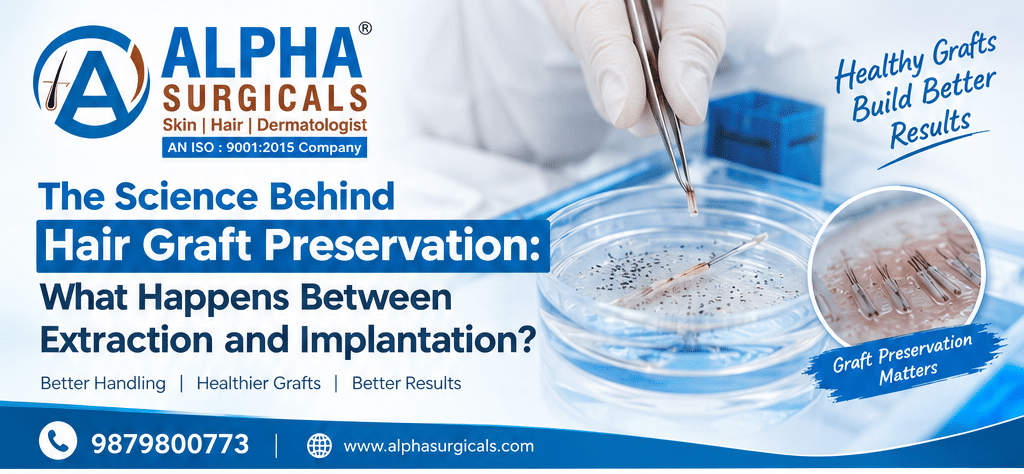
The Science Behind Hair Graft Preservation: What Happens Between Extraction and Implantation?
Understanding the stages of hair graft preservation helps explain why careful workflow management matters.
Stage 1: Extraction and Initial Assessment
During extraction, a trained hair transplant professional removes follicular units from the donor area using the selected technique.
After extraction, the team assesses the grafts and handles them according to the clinical protocol. At this stage, careful technique helps reduce unnecessary mechanical stress.
Suitable extraction instruments can support controlled handling, although outcomes also depend on practitioner skill, patient factors, and the overall procedure.
Stage 2: Transfer to a Suitable Preservation Medium
After extraction, the team transfers grafts to an appropriate preservation medium without unnecessary delay.
The medium should follow the clinical team’s established protocol and the relevant product instructions. Professionals must not assume that every solution offers the same level of protection.
Furthermore, the team should avoid allowing grafts to dry out during transfer or sorting.
Stage 3: Temperature and Storage Management
Temperature is another important consideration in hair graft preservation.
Clinical teams may use controlled cooling as part of their preservation protocol. However, the appropriate temperature depends on the method and medium used. Excessive cooling or freezing can cause harm if the protocol does not support it.
Therefore, professionals should follow established clinical guidance rather than rely on a universal temperature or storage duration.
Stage 4: Sorting and Organization
Before implantation, the team may organize grafts according to the requirements of the procedure.
During this stage, careful handling remains essential. Appropriate trays, storage containers, and instruments can help the team organize grafts and reduce unnecessary transfers.
Moreover, a well-organized workflow can help professionals monitor grafts and coordinate the extraction and implantation stages.
Stage 5: Implantation
Finally, the surgeon places the prepared grafts into the recipient area using the selected implantation technique.
At this stage, suitable instruments and careful handling help the team manage graft placement according to the surgical plan. However, graft survival and final growth depend on multiple factors, including graft quality, surgical technique, patient characteristics, and postoperative care.
For that reason, proper preservation should be considered one part of the complete hair transplantation process rather than a guarantee of a particular result.
Which Factors Can Affect Hair Graft Quality?
Several factors can influence graft condition between extraction and implantation.
Hydration: Professionals must protect grafts from drying out by following an appropriate preservation protocol.
Temperature: The team should maintain the specified storage conditions for the selected medium.
Handling technique: Gentle handling can help limit unnecessary mechanical stress.
Time outside the body: The team should manage the workflow to avoid unnecessary delays.
Preservation medium: Professionals should select a suitable medium based on clinical guidance and product instructions.
Instrument selection: Appropriate extraction, transfer, and implantation instruments can support careful handling throughout the procedure.
Importantly, these factors work together. No single instrument or storage method can independently guarantee successful graft survival.
How Alpha Surgical Supports Hair Transplant Professionals
Alpha Surgical supplies professional instruments and accessories for hair transplantation, dermatology, and aesthetic applications.
The company offers product options designed for different stages of the hair restoration workflow. Depending on the procedure and product specifications, these may include:
- FUE punches: Instruments used by trained professionals for follicular unit extraction.
- Hair transplant implanters: Tools designed to support graft placement using compatible implantation techniques.
- Sapphire blades and handles: Instrument options used in applicable hair restoration procedures.
- Graft handling and storage accessories: Products selected according to the clinical workflow and preservation requirements.
Each product serves a specific purpose. Therefore, professionals should review the specifications and intended use of each instrument before selecting it for their practice.
At Alpha Surgical, we recognize that appropriate instrument selection is an important consideration in a carefully organized hair transplant workflow.
Best Practices for Hair Graft Preservation
Professional teams can support consistent graft handling by following a structured workflow.
- Prepare the workspace: Arrange the necessary instruments and approved storage supplies before extraction begins.
- Follow the clinical protocol: Use the specified preservation medium and storage conditions.
- Handle grafts carefully: Avoid unnecessary transfers and mechanical stress.
- Maintain organization: Keep grafts properly arranged and monitored throughout the procedure.
- Coordinate the workflow: Manage extraction and implantation efficiently without compromising clinical requirements.
- Follow product instructions: Use instruments, containers, and preservation products according to their intended applications.
- Monitor graft handling: Ensure that trained team members follow the established protocol consistently.
By following these principles, clinical teams can manage grafts carefully throughout the procedure.
Conclusion
Hair graft preservation is an important part of the hair transplantation process. From extraction and transfer to storage and implantation, each stage requires attention to hydration, temperature, handling, and timing.
Although careful preservation cannot guarantee a particular clinical outcome, it helps professionals manage grafts under appropriate conditions and minimize avoidable stress.
Alpha Surgical supports hair transplant professionals with a range of instruments and accessories for hair restoration applications. Choosing products that suit the procedure, following established protocols, and maintaining a well-organized workflow all contribute to careful graft management.
Explore Alpha Surgical’s professional hair transplant instrument range to learn more about the products available for your practice.
Follow us on Instagram : https://www.instagram.com/alphasurgicals?igsh=cTdjYWNtaXkxazlr
Follow us on Facebook : https://www.facebook.com/alphasurgicals/
Watch and learn suturing techniques : https://alphasurgicals.com/educational-surgical-videos/
Visit our store to purchase other products : https://alphasurgicals.com/store/