
Follicular Unit Extraction (FUE) is an established hair transplantation technique that relies on specialized instruments for follicular unit extraction. Among these instruments, the FUE punch plays an important role. Its design can influence how the instrument interacts with the surrounding tissue during extraction.
However, choosing a good FUE punch involves more than selecting a particular diameter or looking for a sharp edge. Professionals also consider edge geometry, manufacturing quality, consistency, handling characteristics and compatibility with their preferred clinical approach.
In this article, we explore the essential features of FUE punch design and explain why edge geometry, sharpness and tissue interaction matter. We also discuss how Alpha Surgical supports hair restoration professionals with specialized surgical instruments.
What Is an FUE Punch?
An FUE punch is a specialized cylindrical surgical instrument used by trained professionals during follicular unit extraction.
It is designed to interact with the tissue surrounding individual follicular units. Its dimensions, edge profile and construction influence how it performs within the intended clinical application.
Although the punch may appear simple, small design differences can affect its handling and tissue interaction.
Therefore, professionals should evaluate the complete instrument rather than choosing one based on a single feature.
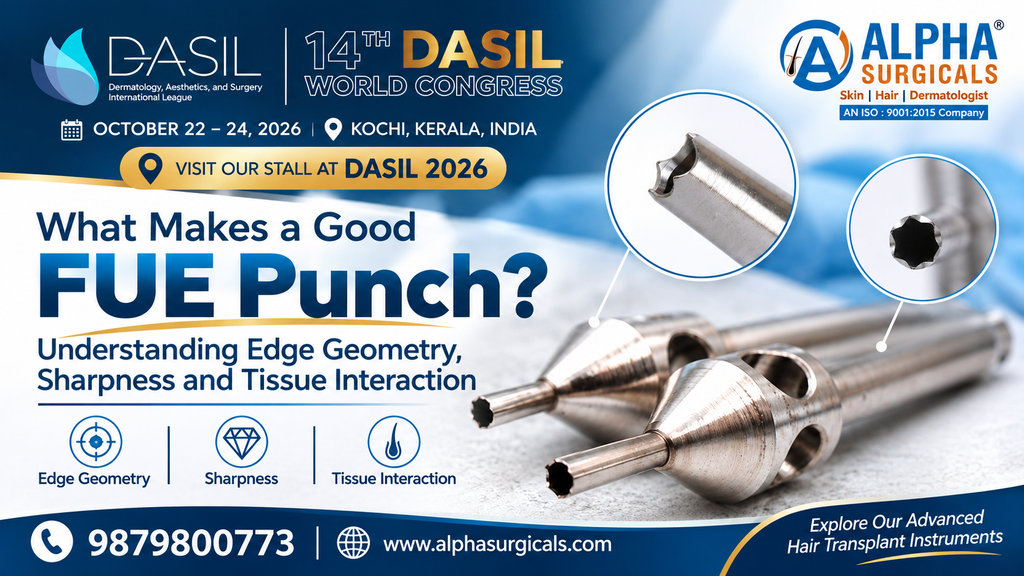
1. Edge Geometry: The Foundation of FUE Punch Design
Edge geometry refers to the shape and configuration of the punch’s working edge. It is one of the important characteristics that distinguish different FUE punch designs.
The working edge determines how the instrument’s surface meets the surrounding tissue. Different edge profiles may produce different interaction characteristics.
Why Edge Geometry Matters
A well-considered edge design aims to provide predictable instrument interaction while supporting the clinician’s chosen extraction approach.
Professionals may evaluate:
- Edge profile: The overall shape and configuration of the working edge.
- Symmetry: Consistency of the edge around the instrument’s circumference.
- Surface finish: Smoothness and quality of the manufactured surface.
- Dimensional consistency: Whether the instrument maintains its intended specifications.
No single edge profile is ideal for every patient or clinical situation. The appropriate design depends on the clinician’s technique, experience and the characteristics of the hair and surrounding tissue.
2. Sharpness: More Than Just a Cutting Edge
Sharpness is another important consideration when evaluating an FUE punch.
A properly manufactured working edge should meet its intended design specifications. However, sharpness alone does not determine instrument quality.
Excessive emphasis on sharpness can overlook other important characteristics, including edge consistency, geometry and overall construction.
What Professionals Should Consider
Consistent edge quality
Manufacturing consistency helps ensure that instruments meet their intended specifications.
Controlled instrument interaction
The relationship between edge geometry and sharpness influences how the punch interacts with surrounding tissue.
Manufacturing precision
Reliable manufacturing and quality checks help maintain consistency between instruments.
Product condition
Professionals should inspect instruments according to applicable quality-control procedures and follow the manufacturer’s guidance for handling and maintenance.
A suitable FUE punch balances its intended sharpness with its overall design and clinical requirements.
3. Tissue Interaction: Why Instrument Design Matters
Tissue interaction describes how an instrument physically engages with the surrounding biological tissue.
During FUE, the punch works in close proximity to delicate follicular structures. Therefore, professionals consider how instrument design may influence tissue interaction.
Factors That Influence Tissue Interaction
Punch geometry
The shape and dimensions of the working edge influence how the instrument interacts with tissue.
Instrument consistency
Manufacturing variations can affect the consistency of the instrument’s working characteristics.
Clinical technique
The clinician’s experience, judgment and chosen technique remain important factors.
Patient-specific characteristics
Hair direction, follicular characteristics and scalp properties vary between individuals. Clinical decisions must account for these differences.
Importantly, no punch design can eliminate tissue-related risks or guarantee a particular extraction result.
4. Understanding Different FUE Punch Design Considerations
FUE punches are available in different designs to meet varying professional preferences and clinical requirements.
When evaluating a punch, professionals may compare the following characteristics:
| Design consideration | Why it matters |
|---|---|
| Diameter | Must suit the intended clinical application and professional assessment |
| Edge geometry | Influences the instrument’s interaction with surrounding tissue |
| Sharpness | Should match the intended design and manufacturing specifications |
| Surface finish | Supports assessment of manufacturing quality |
| Material | Influences durability and compatibility with the manufacturer’s care instructions |
| Handle design | Affects grip and instrument handling |
| Manufacturing consistency | Helps maintain predictable product specifications |
The best choice depends on the complete instrument design rather than one specification in isolation.
5. Manual and Motorized FUE Punch Compatibility
FUE instruments may be designed for manual or motor-assisted systems. These options can differ in handling characteristics and equipment compatibility.
Manual FUE Punches
Manual instruments allow professionals to work with a hand-operated system. Their design and grip are important considerations when evaluating handling preferences.
Motorized FUE Punches
Motorized systems use compatible equipment to support the extraction process. Professionals must consider instrument compatibility and follow the manufacturer’s specifications.
Neither option is automatically suitable for every clinical situation. Selection requires professional assessment and appropriate training.
6. How to Evaluate FUE Punch Quality
A structured product evaluation helps professionals compare instruments more effectively.
Consider these important points:
Manufacturing Quality
Look for clear product specifications and consistent manufacturing standards.
Edge and Surface Finish
Review the instrument’s working edge and finish against the manufacturer’s specifications.
Material and Durability
Understand the material used and the applicable maintenance requirements.
Equipment Compatibility
Confirm that the instrument is suitable for the intended manual or motorized system.
Documentation and Supplier Support
Product information, technical specifications and reliable supplier communication help professionals make informed decisions.
7. Choosing FUE Punch Instruments from Alpha Surgical
Selecting professional hair transplantation instruments requires attention to design, quality and intended application.
Alpha Surgical supplies professional medical and surgical products for dermatology, aesthetic medicine and hair restoration applications.
For professionals evaluating FUE punch instruments, important considerations include:
- Appropriate punch design and dimensions
- Edge geometry and manufacturing consistency
- Material and surface finish
- Compatibility with the intended equipment
- Product specifications and supplier support
Alpha Surgical aims to support hair restoration professionals with practical, quality-focused instrument solutions.
Explore the Alpha Surgical Store to learn more about its professional surgical product range.
For product-related enquiries, contact Alpha Surgical at 9879800773.
8. Why the Right FUE Punch Matters
A good FUE punch is the result of several design and manufacturing considerations working together.
Edge geometry, sharpness, tissue interaction, material quality and instrument compatibility all contribute to its overall suitability.
Nevertheless, instrument selection is only one part of the clinical process. Professional training, patient assessment, technique and established clinical protocols remain essential.
By understanding these factors, hair restoration professionals can make more informed decisions when evaluating FUE punch instruments.
Conclusion
Understanding FUE Punch Design requires looking beyond diameter and sharpness. Edge geometry, manufacturing consistency, surface finish and tissue interaction all deserve attention when evaluating a professional hair transplant instrument.
The right instrument should match the clinician’s technique, equipment requirements and clinical application.
Alpha Surgical supports the hair restoration field with specialized surgical instruments designed for professional applications.
Explore the product range at alphasurgicals.com or contact the team at 9879800773 for more information.
Frequently Asked Questions
1. What makes a good FUE punch?
A good FUE punch combines suitable edge geometry, consistent sharpness, reliable manufacturing quality, appropriate material and compatibility with the intended clinical application.
2. Why is edge geometry important in an FUE punch?
Edge geometry influences how the instrument interacts with surrounding tissue. Professionals evaluate the edge profile, symmetry, finish and dimensional consistency when selecting an instrument.
3. Does a sharper FUE punch always perform better?
No. Sharpness alone does not determine performance. Edge geometry, manufacturing consistency, instrument design and clinical technique also matter.
4. What is tissue interaction in FUE?
Tissue interaction describes how the punch engages with the tissue surrounding follicular units during extraction. Instrument design and professional technique both influence this interaction.
5. Are manual and motorized FUE punches different?
Yes. They may differ in design, handling and equipment compatibility. Professionals should select instruments according to their system and the manufacturer’s specifications.
6. Does punch design guarantee better graft survival?
No. Instrument design cannot guarantee graft survival or a particular clinical outcome. Several factors, including graft characteristics, handling, clinical technique and patient-specific conditions, influence results.
7. How should professionals select an FUE punch?
Professionals should review the instrument’s specifications, edge design, material, manufacturing quality, compatibility and maintenance requirements before selecting a product.
8. Where can professionals explore FUE punch instruments from Alpha Surgical?
Visit Alpha Surgical or contact the team at 9879800773 for product information.
Follow us on Instagram : https://www.instagram.com/alphasurgicals?igsh=cTdjYWNtaXkxazlr
Follow us on Facebook : https://www.facebook.com/alphasurgicals/
Watch and learn suturing techniques : https://alphasurgicals.com/educational-surgical-videos/
Visit our store to purchase other products : https://alphasurgicals.com/store/