Modern medical procedures demand speed, precision, and minimal patient discomfort. Cryosurgery instruments meet these clinical needs by using extreme cold to destroy abnormal or diseased tissue safely. From routine dermatological removals to specialized surgical interventions, these devices have become essential tools in contemporary healthcare facilities. As medical professionals gather at upcoming clinical workshops and surgical exhibitions, Alpha Surgicals continues to showcase how advanced engineering elevates everyday patient care. Understanding the core science behind cryogenic technology and spray tip architecture helps practitioners select reliable tools for consistent clinical outcomes.
What Are Cryosurgery Instruments and How Do They Work?
Cryosurgery instruments are specialized medical devices designed to apply controlled, sub-zero temperatures directly to targeted tissue. Instead of cutting tissue with a scalpel or burning it with electrocautery, cryosurgery freezes cellular water. This rapid temperature drop forms ice crystals inside and outside the cells, disrupting cell membranes and cutting off local blood supply.
As the treated area thaws, the body naturally clears away the damaged cells while healthy surrounding tissue regenerates. Because extreme cold numbs local nerve endings during application, patients typically experience minimal pain. Consequently, clinicians can perform many cryosurgical procedures quickly in an outpatient setting without general anesthesia.
The Core Components of a Cryosurgical Unit
A standard handheld cryogenic delivery system relies on several synchronized parts to maintain safety and accuracy:
- Vacuum-Insulated Flask: This double-walled reservoir stores the cryogen—most commonly liquid nitrogen—while keeping the exterior comfortable and safe for the practitioner to hold.
- Pressure Relief and Control Valve: This mechanism regulates internal vessel pressure and allows the clinician to start or stop the cryogen flow smoothly with a simple trigger press.
- Delivery Tube and Nozzle Assembly: This pathway channels the liquid or vapor from the reservoir to the application point without premature warming.
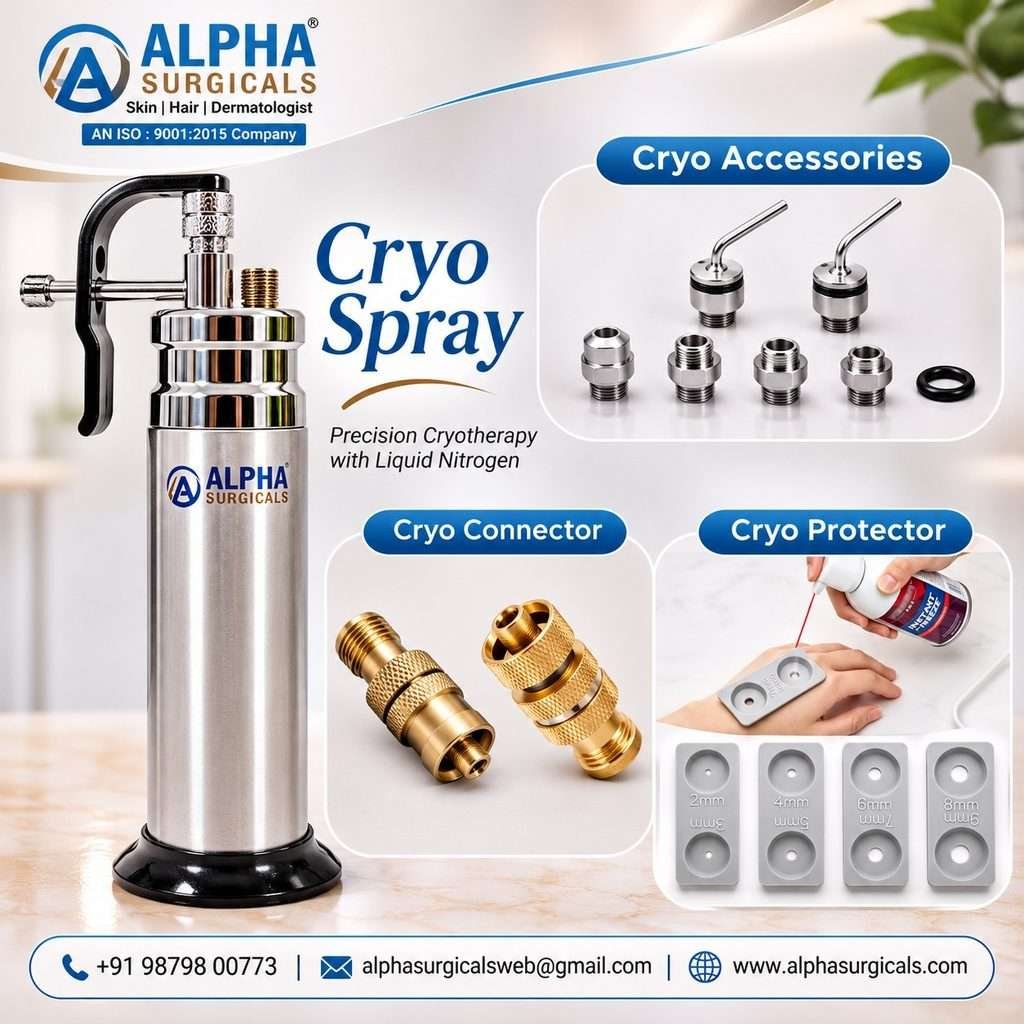
- Interchangeable Spray Tips and Probes: These distal attachments shape the spray pattern or contact area to match the exact size and depth of the lesion.
At medical conferences and hands-on training events, Alpha Surgicals demonstrates how ergonomic balance across these components reduces hand fatigue during back-to-back outpatient sessions.
The Science of Cryogenic Technology in Clinical Practice
Effective cryotherapy depends on rapid freezing followed by a slow, natural thaw. Cryogenic technology achieves this by leveraging the thermodynamic properties of liquefied gases. When liquid nitrogen exits the nozzle at extremely low temperatures, it absorbs heat rapidly from the target tissue upon contact.
Controlling this thermal transfer is critical. If the freeze happens too slowly, cells may adapt and survive. Conversely, an uncontrolled freeze can damage healthy adjacent skin or underlying structures. Therefore, modern cryosurgery instruments are engineered to deliver a steady, predictable flow rate. This thermal consistency ensures that practitioners achieve the necessary depth of freeze without guesswork.
Open-Spray Technique vs. Closed-Probe Technique
Depending on the clinical specialty and lesion type, practitioners generally choose between two primary application methods:
- Open-Spray Method: The clinician directs a fine mist of cryogen from a short distance onto the skin surface. This non-contact approach works well for irregular, raised, or superficial skin lesions because the spray conforms naturally to uneven contours.
- Closed-Probe Method: The cryogen circulates inside a sealed metal tip without touching the patient directly. The practitioner presses the chilled metal probe against the tissue, making it ideal for flat lesions, mucosal surfaces, or areas near sensitive anatomical structures like the eyes.
Why Spray Tip Design Matters for Surgical Precision
While the reservoir holds the cooling agent, the nozzle dictates clinical accuracy. Thoughtful spray tip design separates basic devices from high-precision cryosurgery instruments. Even slight variations in aperture diameter or internal geometry change how the cryogen disperses upon exit.
A well-engineered spray tip prevents sputtering, minimizes liquid dripping, and maintains a focused freeze zone. When clinicians evaluate new equipment at live demonstrations hosted by Alpha Surgicals, spray pattern stability is consistently one of the first features they inspect.
Matching Aperture Sizes to Lesion Profiles
Most professional cryo units include a set of color-coded or clearly marked apertures to accommodate diverse clinical scenarios:
- Fine-Aperture Tips: Narrow openings produce a concentrated, pinpoint stream. Clinicians use these for small, delicate lesions such as skin tags, tiny warts, or spots on the face and fingers where sparing surrounding skin is crucial.
- Medium-Aperture Tips: Standard openings deliver a balanced cone of spray suitable for everyday dermatological treatments, including actinic keratoses and common verrucae.
- Wide-Aperture Tips: Larger openings release a broader, higher-volume spray. These are useful for larger surface areas or thicker lesions that require faster heat extraction.
- Bent or Angled Extensions: Extended, curved needles allow practitioners to reach difficult anatomical zones—such as behind the ears, inside the nasal cavity, or along the scalp—while maintaining a clear line of sight.
Key Clinical Applications Across Specialties
Because extreme cold acts as both a destructive and hemostatic agent, cryosurgery instruments serve multiple medical disciplines:
- Dermatology: Practitioners routinely treat benign and premalignant skin growths, seborrheic keratoses, solar lentigines, and keloids with high cosmetic satisfaction.
- Gynecology: Specialized cryo probes help manage benign cervical lesions safely in outpatient clinics.
- General and Podiatric Surgery: Clinicians address plantar warts, neuromas, and localized soft-tissue lesions with minimal downtime for the patient.
- Veterinary Medicine: Veterinary surgeons also rely on portable cryo units for quick, non-invasive removal of superficial growths in animals.
During upcoming healthcare trade events, Alpha Surgicals highlights versatile instrument configurations that support multi-specialty clinics looking to expand their procedural capabilities.
Best Practices for Maintaining Cryosurgery Instruments
Proper care extends the lifespan of your equipment and ensures reliable performance during every procedure. Follow these essential maintenance steps in your clinic:
- Depressurize Safely After Use: Always release internal pressure gradually according to manufacturer instructions before removing the cap or storing the unit.
- Inspect O-Rings and Seals Regularly: Check gaskets and valve seals for wear or brittleness caused by repeated thermal cycling, replacing them promptly to prevent leaks.
- Clean and Sterilize Tips Between Patients: Follow standard clinical infection-control protocols to clean and sterilize reusable spray tips and closed probes after each use.
- Store in a Dry, Well-Ventilated Area: Keep the empty flask dry with the cap loosened when not in use so residual moisture does not freeze inside the valve mechanism.
Reliable after-sales guidance from Alpha Surgicals ensures that hospital biomedical teams and private practitioners keep their cryo systems operating smoothly year-round.
Why Healthcare Providers Trust Alpha Surgicals
Selecting dependable surgical tools directly impacts procedural efficiency and patient trust. Alpha Surgicals focuses on supplying durable, ergonomically balanced cryosurgery instruments built for real-world clinical demands. Whether you are equipping a new dermatology clinic, upgrading hospital outpatient rooms, or attending an upcoming medical event to test instruments firsthand, Alpha Surgicals provides responsive support and practical solutions tailored to healthcare professionals.
Upgrade Your Clinical Practice Today
Ready to explore precision cryosurgery instruments for your clinic or hospital? Connect directly with the team at Alpha Surgicals for product demonstrations, event schedules, and ordering assistance. Call 9879800773 today or visit alphasurgicals.com to speak with a specialist.
Frequently Asked Questions (FAQs)
1. What cryogen is most commonly used in handheld cryosurgery instruments?
. Liquid nitrogen is the most widely used cryogen in clinical practice because its ultra-low boiling point allows rapid, deep freezing of targeted tissue.
2. How do I choose the right spray tip size for a procedure?
. Select the aperture based on the diameter and depth of the lesion. Use fine apertures for small, delicate facial or digital lesions, and wider apertures for larger or thicker growths requiring broader coverage.
3. What is the difference between an open spray tip and a closed contact probe?
. An open spray tip directs cryogen mist directly onto the tissue without physical contact, whereas a closed contact probe cools a solid metal tip that touches the tissue surface to transfer cold via conduction.
4. Are cryosurgery spray tips reusable?
. Most metal spray tips and closed probes are designed for repeated clinical use, provided they are properly cleaned and sterilized between patients according to standard medical hygiene guidelines.
5. Where can I inquire about cryosurgery instruments from Alpha Surgicals?
. You can visit alphasurgicals.com or call 9879800773 to get full details on available cryosurgery units, accessories, and upcoming event showcases.
Follow us on Instagram : https://www.instagram.com/alphasurgicals?igsh=cTdjYWNtaXkxazlr
Follow us on Facebook : https://www.facebook.com/alphasurgicals/
Watch and learn suturing techniques : https://alphasurgicals.com/educational-surgical-videos/
Visit our store to purchase other products : https://alphasurgicals.com/store/