Dermatology requires more than theoretical knowledge. Healthcare professionals also need practical skills, proper instrument handling and procedural confidence to perform dermatological procedures effectively. Therefore, hands-on training plays an important role in professional development.
Surgical Simulation Kits provide a structured way for trainees to practise selected surgical techniques in a controlled learning environment. These training tools allow learners to understand instrument handling, develop hand-eye coordination and repeat basic procedural tasks before progressing to supervised clinical training.
At Alpha Surgical, we recognize the importance of quality surgical instruments and practical training solutions in dermatology. Simulation-based learning can help bridge the gap between theoretical knowledge and practical skill development.
What Are Surgical Simulation Kits?
Surgical Simulation Kits are educational tools designed to help healthcare trainees practise surgical techniques using simulated materials rather than immediately practising on patients.
Depending on their design, these kits may include:
- Synthetic skin or silicone practice pads
- Surgical training instruments
- Suturing practice materials
- Needle holders and forceps
- Surgical scissors
- Training models for selected procedural techniques
- Practice accessories for basic surgical exercises
These components create opportunities for repeated practice in a controlled environment.
Moreover, different simulation kits support different learning objectives. Therefore, educators should select training materials according to the skills they want trainees to develop.
Why Are Surgical Simulation Kits Important in Dermatology?
Dermatology includes several procedures that require precision, coordination and appropriate instrument handling.
For example, trainees may need to learn suturing, biopsy techniques, wound closure and basic surgical instrument handling.
Surgical Simulation Kits provide opportunities to practise these foundational skills before applying them in supervised clinical settings.
Here are some important benefits.
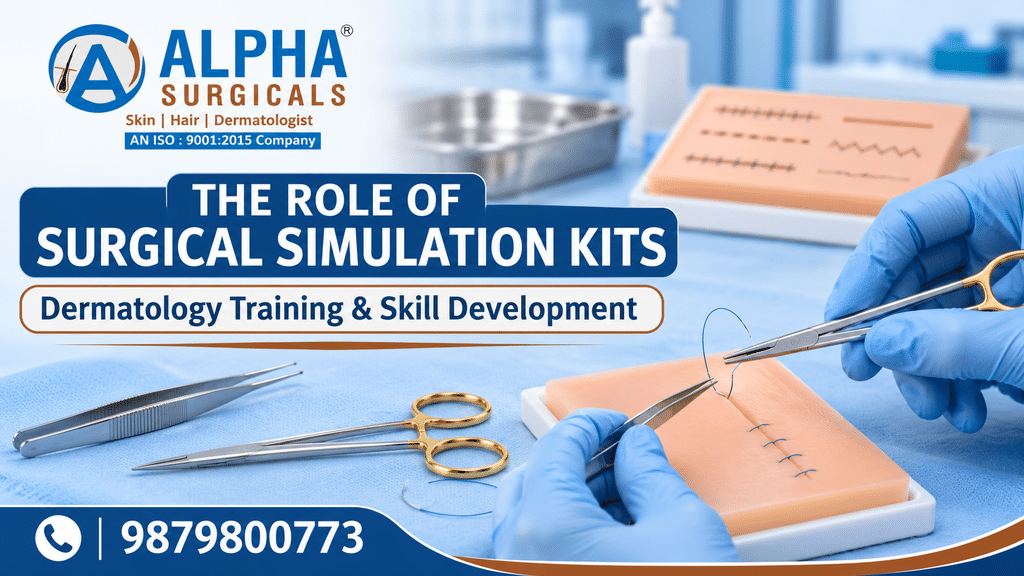
1. Develops Practical Surgical Skills
Theoretical learning provides essential procedural knowledge. However, trainees also need practical experience to understand how surgical instruments work.
Simulation-based training allows learners to practise basic techniques using suitable models.
For example, synthetic skin pads can help trainees understand needle handling, suture placement and basic wound closure techniques.
As a result, learners can develop familiarity with common surgical instruments and procedural steps.
2. Improves Hand-Eye Coordination
Dermatological procedures often require controlled movements and accurate instrument handling.
Surgical Simulation Kits allow trainees to repeat specific tasks while observing their hand movements.
Through regular supervised practice, learners can work on:
- Instrument positioning
- Hand coordination
- Needle handling
- Suture placement
- Controlled movements
- Procedural consistency
Furthermore, instructors can identify areas that need improvement and provide immediate feedback.
3. Supports Repeated Practice
One important advantage of simulation-based learning is the opportunity to repeat specific tasks.
Unlike a one-time demonstration, a practice model allows trainees to revisit techniques and work on areas that need improvement.
For instance, learners can repeat basic suturing exercises until they become more familiar with the sequence of movements.
Consequently, structured repetition can support progressive skill development.
4. Builds Procedural Confidence
Learning a new surgical technique can be challenging, particularly for beginners.
Simulation-based training gives learners an opportunity to understand procedural steps before participating in supervised clinical procedures.
Additionally, instructors can demonstrate techniques, observe trainee performance and provide constructive feedback.
This learning process can help improve confidence and familiarity with surgical instruments.
However, confidence alone does not establish clinical competence. Trainees still require appropriate assessment and supervised clinical experience.
5. Encourages Better Instrument Familiarity
Dermatology professionals work with different surgical instruments, each designed for particular functions.
Simulation kits can help trainees become familiar with instruments such as:
- Surgical forceps
- Needle holders
- Surgical scissors
- Biopsy instruments
- Suturing accessories
- Other procedure-specific training tools
By practising with appropriate instruments, learners can understand their design, handling characteristics and intended applications.
At Alpha Surgical, we understand the importance of selecting suitable instruments for professional dermatology requirements.
Types of Surgical Simulation Models Used in Dermatology Training
Different training models support different procedural learning objectives.
1. Synthetic Skin Models
Synthetic skin models provide a practice surface for basic surgical exercises.
Trainees can use suitable models to practise suturing, incision-related exercises and wound closure techniques.
These models are particularly useful for structured skills sessions because educators can repeat demonstrations and assess performance.
2. Silicone Suturing Pads
Silicone suturing pads are commonly used for practising basic suturing techniques.
They provide a reusable or replaceable training surface, depending on the product design.
Trainees can practise needle handling, suture placement and knot-tying techniques under instructor supervision.
3. Anatomical Training Models
Anatomical models help learners understand selected anatomical relationships and procedural concepts.
Depending on their design, these models can support teaching about tissue structures, surgical planning and technique selection.
4. Cadaver-Based Simulation
Cadaveric simulation can provide additional anatomical learning opportunities in appropriately supervised educational settings.
It allows trainees to study anatomical relationships and practise selected surgical concepts.
However, this approach requires specialized facilities, institutional approval and appropriate ethical and safety procedures.
5. Procedure-Specific Training Models
Some training models focus on individual dermatological procedures.
For example, educators may use different models to teach punch biopsy concepts, elliptical excision, wound closure and flap-design principles.
Therefore, choosing a model according to the learning objective is important.
Essential Skills Trainees Can Develop Through Surgical Simulation Kits
A well-planned simulation curriculum can address several foundational surgical competencies.
Suturing Techniques
Trainees can practise basic suturing patterns, needle handling and knot tying using suitable synthetic skin models.
Instrument Handling
Learners can become familiar with the correct handling and functional differences between surgical instruments.
Hand Coordination
Repeated practice helps trainees work on controlled movements and coordination.
Procedural Planning
Simulation exercises can introduce the sequence of selected procedures, including preparation, instrument selection and procedural steps.
Technical Assessment
Instructors can evaluate trainee performance using structured assessment methods.
For example, they may assess instrument handling, accuracy, technique and procedural consistency.
How Simulation-Based Training Improves Dermatology Education
Effective training requires more than providing a practice kit.
Educators should combine demonstrations, structured exercises, repeated practice and performance feedback.
A practical training programme can follow these stages:
Step 1: Introduce the Instruments
Explain the purpose, design and appropriate handling of each training instrument.
Step 2: Demonstrate the Technique
An instructor demonstrates the relevant procedural concept and explains the important steps.
Step 3: Practise on Simulation Models
Trainees repeat the exercise using suitable synthetic skin or other training materials.
Step 4: Provide Feedback
The instructor evaluates performance and identifies areas that need improvement.
Step 5: Assess Skill Development
Educators use suitable assessment methods to monitor progress and determine whether further practice is necessary.
This structured approach supports more organized learning.
What to Consider When Selecting Surgical Simulation Kits
Not every simulation kit supports the same learning objectives. Therefore, educational institutions and dermatology training centres should evaluate several factors before selecting training products.
1. Training Purpose
Identify the specific procedures or skills that trainees need to practise.
2. Material Quality
Evaluate the material used in the practice model and its suitability for the intended training exercises.
3. Instrument Selection
Choose instruments that match the skills being taught.
4. Ease of Handling
Training materials should allow learners to practise comfortably under instructor supervision.
5. Reusability and Maintenance
Check the manufacturer’s instructions regarding cleaning, maintenance, replacement and reuse.
6. Training Compatibility
Ensure that the selected kit supports the planned curriculum and assessment requirements.
These factors can help educators select practical and appropriate simulation products.
The Role of Alpha Surgical in Dermatology Training and Instrument Selection
At Alpha Surgical, we understand the importance of reliable surgical instruments and practical equipment in dermatology and aesthetic medicine.
Our product focus includes professional surgical instruments, dermatology products, hair restoration instruments and related medical solutions.
We recognize that instrument selection is an important consideration in both clinical practice and educational settings.
For dermatology training centres and healthcare professionals, choosing suitable instruments and training accessories can support organized procedural education.
Alpha Surgical focuses on product quality, reliability and practical clinical requirements.
Explore our product range to learn more about our surgical and dermatology solutions.
Website: https://alphasurgicals.com/store/
Conclusion
Surgical Simulation Kits play a valuable role in dermatology education by providing opportunities for structured practice, instrument familiarity and foundational procedural skill development.
From synthetic skin models to suturing pads and anatomical training tools, different simulation products support different learning objectives.
Furthermore, combining practical exercises with demonstrations, instructor feedback and structured assessments can improve the overall learning experience.
At Alpha Surgical, we believe that suitable surgical instruments and practical training solutions are important considerations for the continued development of dermatology professionals.
Frequently Asked Questions (FAQs)
1. What are Surgical Simulation Kits used for in dermatology?
Surgical Simulation Kits help dermatology trainees practise selected procedural techniques, including suturing, instrument handling and basic surgical exercises, using simulated training materials.
2. How do Surgical Simulation Kits improve surgical skills?
They provide opportunities for repeated practice, instructor feedback and structured assessment. These activities can help trainees develop instrument familiarity and procedural techniques.
3. Which simulation models are used in dermatology training?
Common options include synthetic skin pads, silicone suturing models, anatomical models and selected cadaver-based training approaches.
4. Can beginners use Surgical Simulation Kits?
Yes. Suitable training models can introduce beginners to basic instrument handling and foundational procedural techniques under appropriate supervision.
5. Do simulation kits replace clinical training?
No. Simulation supports practical learning but does not replace supervised clinical experience, professional instruction or competency assessment.
6. What should educators consider when choosing a surgical simulation kit?
Educators should evaluate training objectives, material quality, instrument selection, handling, maintenance requirements and compatibility with the educational programme.
7. Why is suturing practice important in dermatology?
Suturing practice helps trainees understand needle handling, suture placement, knot tying and basic wound closure concepts.
Call to Action
Looking for reliable surgical instruments and dermatology products?
Choose Alpha Surgical for professional surgical and dermatology product solutions designed around practical clinical requirements.
Contact: 9879800773
Alpha Surgical – Skin | Hair | Dermatologist.
Follow us on Instagram : https://www.instagram.com/alphasurgicals?igsh=cTdjYWNtaXkxazlr
Follow us on Facebook : https://www.facebook.com/alphasurgicals/
Watch and learn suturing techniques : https://alphasurgicals.com/educational-surgical-videos/
Visit our store to purchase other products : https://alphasurgicals.com/store/