Skin grafting plays an important role in reconstructive surgery, dermatology and wound management. It helps restore skin coverage when wounds cannot heal adequately through natural processes or primary closure.
However, successful skin grafting involves more than selecting suitable donor tissue. One important consideration is skin graft thickness. The amount of dermis included in a graft can influence its survival, contraction, durability, appearance and suitability for the recipient site.
For surgeons and dermatology professionals, understanding these differences supports more informed surgical planning.
In this article, we explore how graft thickness affects clinical considerations, compare split-thickness and full-thickness skin grafts, and explain why precision in surgical instrumentation matters.
What Is Skin Grafting?
Skin grafting is a reconstructive technique in which skin tissue is transferred from a donor site to a recipient site to cover a skin defect.
The graft does not initially carry its own independent blood supply. Instead, it relies on the recipient wound bed for nutrients and subsequent vascular connections.
Skin grafting may be considered in situations involving:
- Skin loss following trauma
- Selected burn injuries
- Defects following surgical excision
- Certain chronic wounds
- Reconstructive procedures requiring additional skin coverage
The choice of graft depends on the wound characteristics, recipient-site blood supply, anatomical location, functional requirements and available donor tissue.
Understanding Skin Graft Thickness
Skin graft thickness refers to the amount of skin tissue transferred from the donor site.
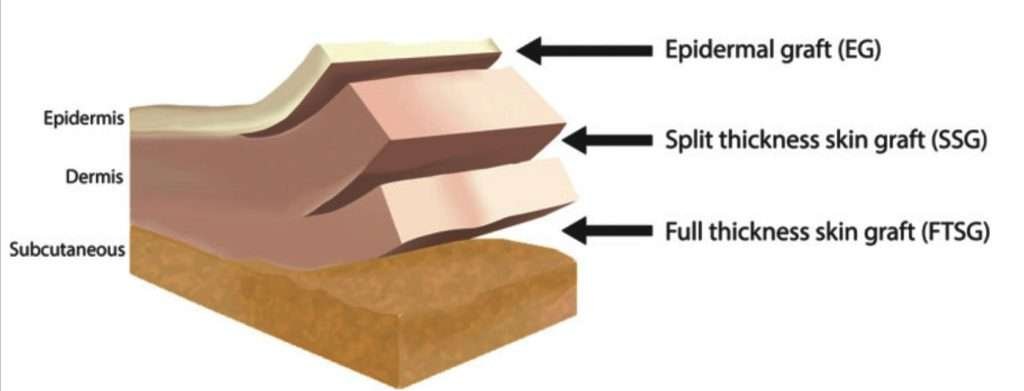
The epidermis is present in both major graft categories. The main difference is the amount of dermis included.
Broadly, skin grafts are classified into two categories:
- Split-Thickness Skin Graft (STSG)
- Full-Thickness Skin Graft (FTSG)
Each has different characteristics that influence surgical planning.
1. Split-Thickness Skin Graft (STSG)
A split-thickness skin graft contains the epidermis and a portion of the dermis.
Because it contains less dermal tissue than a full-thickness graft, it generally has different requirements for vascular support, donor-site healing and long-term contraction.
Split-thickness grafts are commonly considered for larger skin defects where extensive coverage is required.
Key Characteristics
- Includes the epidermis and part of the dermis.
- Generally has a greater capacity to survive on a comparatively less vascular wound bed than a full-thickness graft.
- The donor site can re-epithelialize because some dermal structures remain.
- Can be expanded through meshing when additional coverage is required.
- Generally demonstrates greater secondary contraction than full-thickness grafts.
Clinical Considerations
Split-thickness grafts are useful when wound coverage and donor-tissue availability are important considerations.
However, the amount of dermis included can influence durability, appearance and subsequent contraction. Therefore, graft thickness requires careful evaluation according to the clinical requirements.
2. Full-Thickness Skin Graft (FTSG)
A full-thickness skin graft contains the epidermis and the entire dermis.
The greater amount of dermal tissue provides different mechanical and aesthetic characteristics compared with split-thickness grafts.
These grafts are frequently considered for selected smaller defects where tissue quality, appearance and resistance to secondary contraction are important.
Key Characteristics
- Includes the epidermis and entire dermis.
- Generally provides greater tissue durability.
- Usually demonstrates less secondary contraction.
- Can offer favourable texture and colour matching when an appropriate donor site is selected.
- Requires a well-vascularized recipient bed for successful integration.
- The donor site generally requires primary closure or an alternative closure plan.
Clinical Considerations
Full-thickness grafts may be appropriate for selected facial, eyelid, ear and hand defects.
However, their use depends on wound size, vascularity, donor-site availability and the patient’s individual circumstances.
3. How Graft Thickness Influences Surgical Planning
Selecting an appropriate graft thickness involves balancing several clinical factors.
A. Graft Survival
One of the most important considerations is the ability of the graft to receive adequate nourishment from the recipient wound bed.
Initially, the graft depends on diffusion of nutrients from the underlying tissue. Subsequently, vascular connections develop.
Thinner split-thickness grafts generally have lower metabolic requirements during early integration and can tolerate comparatively less vascular recipient beds.
In contrast, thicker grafts require a more supportive vascular environment.
Therefore, recipient-site quality is an important consideration when evaluating graft thickness.
B. Wound Contraction
Contraction is another important factor in graft selection.
Skin grafts can undergo contraction immediately after harvesting and during subsequent healing.
The amount of dermis included influences this process.
- Split-thickness grafts generally experience greater secondary contraction.
- Full-thickness grafts generally demonstrate less secondary contraction.
- The location and functional importance of the wound influence how much contraction matters clinically.
This is particularly relevant in areas surrounding joints, eyelids, fingers and other structures where excessive contraction may affect function or appearance.
C. Durability and Tissue Quality
The dermis contributes to skin strength, elasticity and structural support.
Consequently, grafts containing more dermal tissue generally provide greater durability than thinner grafts.
This consideration can become important in areas exposed to movement, friction or mechanical stress.
However, greater thickness also increases the demands on recipient-site vascularity.
D. Aesthetic Considerations
The final appearance of a graft depends on several factors, including:
- Donor-site characteristics
- Skin colour and texture
- Anatomical location
- Graft thickness
- Healing and scar formation
- Secondary contraction
Full-thickness grafts can offer favourable aesthetic characteristics in selected reconstructive situations.
Nevertheless, achieving a good tissue match requires individual assessment rather than thickness selection alone.
4. Split-Thickness vs Full-Thickness Skin Grafts
Understanding their differences helps explain why surgeons select different graft types for different clinical requirements.
| Feature | Split-Thickness Graft | Full-Thickness Graft |
|---|---|---|
| Tissue included | Epidermis and part of dermis | Epidermis and entire dermis |
| Dermal content | Partial | Complete |
| Wound-bed vascularity | Comparatively less demanding | Greater vascular support required |
| Secondary contraction | Generally greater | Generally less |
| Durability | Comparatively lower | Generally higher |
| Donor-site healing | Re-epithelialization | Usually requires closure planning |
| Typical consideration | Larger defects | Selected smaller defects requiring tissue quality |
Neither graft type is universally superior. The choice depends on the recipient site, wound characteristics, available donor tissue and clinical objectives.
5. Understanding Thickness Categories
Split-thickness grafts are often described as thin, intermediate or thick.
One commonly cited classification uses the following approximate ranges:
| Classification | Thickness |
|---|---|
| Thin STSG | 0.15–0.30 mm |
| Intermediate STSG | 0.30–0.45 mm |
| Thick STSG | 0.45–0.60 mm |
These ranges are not universal manufacturing or clinical standards. Published classifications may differ, and graft selection must account for patient anatomy and clinical requirements.
The important consideration is consistency and suitability rather than relying on a numerical thickness in isolation.
6. Donor-Site Selection and Its Importance
Graft planning also involves evaluating the donor site.
The donor site must provide tissue with suitable characteristics while considering healing, scarring and the amount of tissue available.
Important considerations include:
Skin Characteristics
Thickness, texture, colour and elasticity can vary between anatomical locations.
Matching these characteristics to the recipient site can influence the final reconstructive appearance.
Donor-Site Healing
Split-thickness graft donor sites retain some dermal structures that support re-epithelialization.
Full-thickness graft donor sites generally require a different closure strategy.
Tissue Availability
The size of the defect and the amount of available donor tissue influence the reconstructive options.
Consequently, donor-site planning remains an important part of overall surgical decision-making.
7. The Importance of Precision in Skin Grafting Instruments
Graft quality depends on clinical judgement as well as the consistency and suitability of surgical instruments.
Specialised skin-grafting instruments support professional requirements related to tissue handling and reconstructive procedures.
Important instrument-quality considerations include:
- Manufacturing consistency
- Appropriate material quality
- Dimensional accuracy
- Reliable instrument performance
- Surface finish
- Compatibility with intended clinical applications
- Suitable cleaning, sterilisation and reprocessing requirements
Precision in instrumentation helps support a controlled clinical environment.
At Alpha Surgical, we recognise the importance of dependable surgical instruments across dermatology, aesthetic medicine and reconstructive applications.
8. Why Instrument Quality Matters to Alpha Surgical
At Alpha Surgical, we focus on professional surgical and dermatology instrumentation designed around practical clinical requirements.
Skin grafting highlights the importance of precision, consistency and suitable instrument selection.
While the surgeon’s expertise and clinical planning remain central to patient outcomes, appropriately designed instruments are an important part of the broader surgical environment.
Alpha Surgical is committed to supporting dermatology and surgical professionals with quality-focused instrumentation and solutions.
Conclusion
Skin graft thickness is an important consideration in reconstructive planning because it influences graft survival, contraction, durability, donor-site healing and aesthetic outcomes.
Split-thickness grafts can offer advantages when larger areas require coverage, while full-thickness grafts may provide favourable durability and reduced secondary contraction in selected anatomical locations.
Ultimately, the appropriate graft depends on recipient-site vascularity, wound characteristics, donor-site availability and the intended functional and aesthetic outcome.
At Alpha Surgical, we believe precision in surgical instrumentation and an understanding of clinical requirements go hand in hand.
For professional surgical and dermatology instrument enquiries, contact Alpha Surgical at 9879800773.
Frequently Asked Questions (FAQs)
1. What is skin graft thickness?
Skin graft thickness refers to the amount of tissue transferred from the donor site, particularly the amount of dermis included with the epidermis.
2. What are the two main types of skin grafts?
The two main types are split-thickness skin grafts, which contain the epidermis and part of the dermis, and full-thickness skin grafts, which contain the epidermis and entire dermis.
3. How does graft thickness affect graft survival?
Thinner grafts generally require less vascular support during early integration. Thicker grafts have greater metabolic requirements and depend on a well-vascularized recipient bed.
4. Which graft type undergoes greater secondary contraction?
Split-thickness grafts generally undergo greater secondary contraction than full-thickness grafts.
5. Why are full-thickness grafts considered for facial reconstruction?
They can provide favourable tissue durability, appearance and reduced secondary contraction in selected facial defects. Their suitability depends on the wound and donor-site characteristics.
6. Does a thicker skin graft always provide better results?
No. Greater thickness can improve durability and reduce secondary contraction, but it also increases the requirements for recipient-site vascularity. The appropriate choice depends on the clinical situation.
7. What factors influence skin graft selection?
Important factors include wound size, recipient-site vascularity, anatomical location, functional requirements, donor-site availability, tissue characteristics and anticipated contraction.
8. Why is instrument precision important in skin grafting?
Consistent, suitable surgical instruments support professional requirements for tissue handling, accuracy and reliable performance.
9. Where can professionals enquire about surgical instruments?
Professionals can contact Alpha Surgical for enquiries about its range of dermatology, surgical and specialised clinical instruments.
Contact Alpha Surgical: 9879800773
Follow us on Instagram : https://www.instagram.com/alphasurgicals?igsh=cTdjYWNtaXkxazlr
Follow us on Facebook : https://www.facebook.com/alphasurgicals/
Watch and learn suturing techniques : https://alphasurgicals.com/educational-surgical-videos/
Visit our store to purchase other products : https://alphasurgicals.com/store/