Hair transplantation has evolved significantly with the development of specialized instruments designed to support controlled graft placement. One technique receiving attention is No-Touch Hair Graft Implantation, which focuses on minimizing direct contact with delicate hair graft tissue during the implantation process.
Modern hair implanter pens support a more controlled approach to graft placement. They allow trained hair restoration professionals to manage the placement process while reducing unnecessary handling of the graft.
In this article, we explore the concept of no-touch implantation, how implanter pens work, their potential advantages, and the importance of selecting suitable instruments. We also look at how Alpha Surgical supports hair restoration professionals with specialized surgical products.
What Is No-Touch Hair Graft Implantation?
No-touch hair graft implantation describes an approach that aims to minimize direct handling of extracted hair grafts during placement.
A hair graft contains follicles and surrounding tissue that require careful handling. Excessive or unnecessary manipulation may affect graft integrity. Therefore, reducing avoidable contact is an important consideration during hair transplantation.
The term “no-touch” does not mean that grafts are never handled. Instead, it generally refers to techniques and instruments designed to limit direct contact with the delicate graft tissue.
The exact technique can vary according to the clinician’s preferred method, equipment and treatment plan.
Understanding Modern Hair Implanter Pens
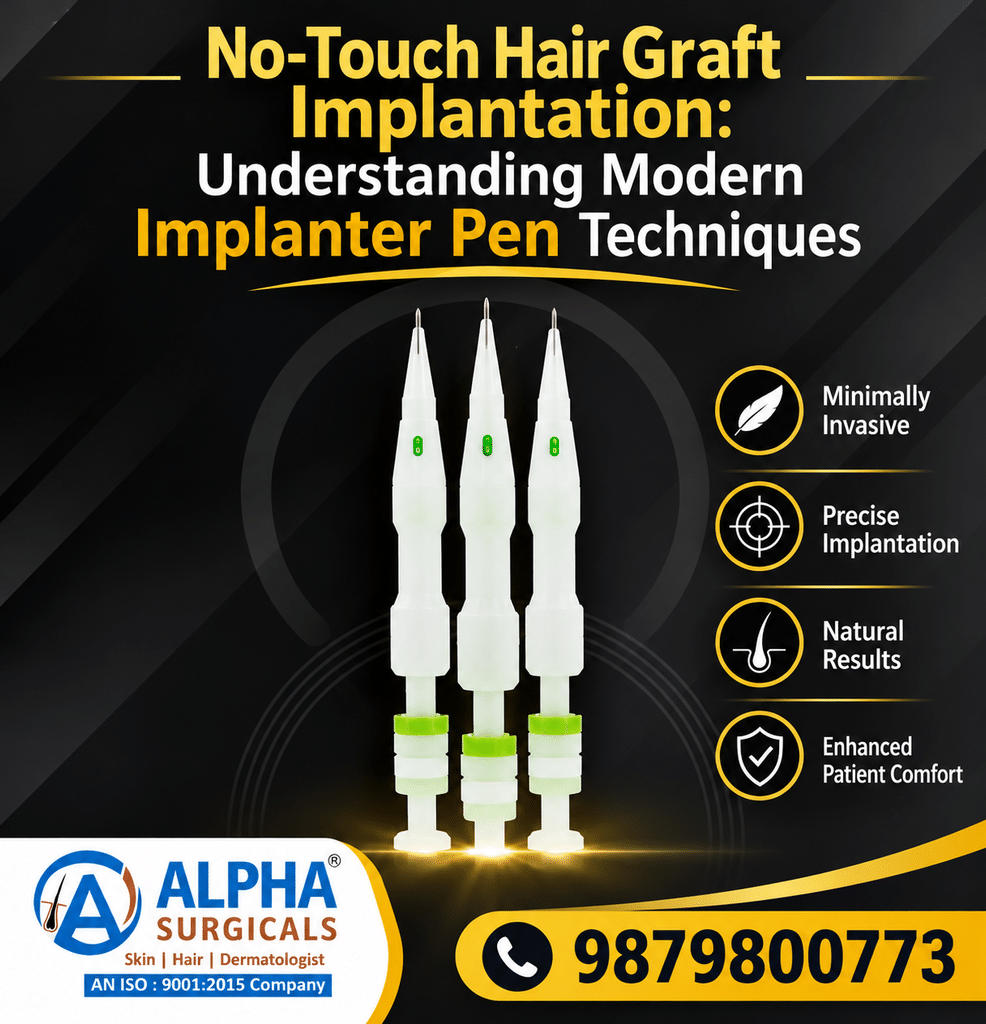
A hair implanter pen is a specialized instrument used by trained professionals to place hair grafts into the recipient area.
Its design typically includes a hollow needle or tip and a loading mechanism. The instrument holds the graft and supports controlled placement.
Implanter pens are commonly associated with Direct Hair Implantation (DHI) approaches. However, the use of an implanter pen alone does not define an entire hair transplantation method.
Key Components of an Implanter Pen
1. Needle or tip
The tip accommodates the graft and is selected according to clinical requirements, graft characteristics and the instrument’s compatibility.
2. Loading mechanism
The loading system helps position the graft within the instrument while aiming to minimize unnecessary handling.
3. Pen body and grip
The body provides the clinician with a controlled grip and supports instrument handling during the procedure.
4. Ejection mechanism
The mechanism helps release the graft from the instrument during placement. Its design and operation depend on the specific model.
How Does the No-Touch Approach Work?
The no-touch concept focuses on reducing unnecessary contact with graft tissue. The process involves several stages managed by qualified hair restoration professionals.
1. Careful Graft Assessment
After extraction, professionals assess the grafts and handle them according to established clinical protocols. Graft quality, tissue integrity and storage conditions remain important considerations.
2. Appropriate Graft Loading
A compatible implanter pen can help position a graft within the instrument. The loading method should follow the manufacturer’s instructions and the clinician’s training.
3. Controlled Placement
The implanter pen supports the clinician’s control over graft placement. Factors such as angle, direction, depth and recipient-area planning require professional judgment.
4. Attention to Graft Handling
The overall objective is to avoid unnecessary manipulation and maintain appropriate graft care throughout the procedure.
No instrument can eliminate every handling-related risk. Proper technique, instrument quality and clinical protocols all matter.
Potential Advantages of Implanter Pen Techniques
Implanter pens offer several potential advantages when selected and used appropriately by trained professionals.
Reduced Direct Graft Handling
The instrument can help limit unnecessary contact with graft tissue during placement. This supports a careful approach to graft management.
Controlled Placement
The pen design gives clinicians an instrument for managing graft placement. However, placement accuracy still depends on professional skill and planning.
Consistent Instrument Handling
A well-designed pen may offer a familiar grip and predictable handling characteristics. This can support workflow consistency during lengthy procedures.
Support for Different Clinical Requirements
Implanter pens are available in different designs and tip configurations. Professionals select compatible options based on graft characteristics, clinical needs and manufacturer guidance.
Implanter Pen vs. Traditional Forceps-Based Placement
Both approaches have a role in hair transplantation. The appropriate choice depends on the clinician’s experience, preferred technique and the requirements of the procedure.
| Feature | Implanter pen approach | Forceps-based approach |
|---|---|---|
| Instrument | Specialized implanter pen | Fine surgical forceps |
| Graft handling | Designed to limit direct contact during placement | Requires direct instrument handling |
| Placement control | Pen-based placement system | Controlled through forceps and recipient-site preparation |
| Technique | Often associated with DHI approaches | Used in several hair transplantation workflows |
| Selection | Depends on clinician preference and compatibility | Depends on clinician preference and clinical workflow |
Neither approach is automatically superior in every situation. Outcomes depend on multiple factors, including clinical planning, professional expertise, graft care and patient-specific considerations.
Factors to Consider When Selecting a Hair Implanter Pen
Choosing a suitable implanter pen requires attention to more than appearance or price.
Tip Compatibility
The tip should be compatible with the instrument and appropriate for the intended clinical application.
Ergonomic Design
A comfortable grip and balanced design may support instrument control during extended procedures.
Material and Build Quality
Professionals should consider material quality, construction and the manufacturer’s instructions for cleaning, sterilization and reuse, where applicable.
Reliable Performance
The loading and ejection mechanisms should function consistently according to the product’s specifications.
Manufacturer Support
Product documentation, technical information and dependable supplier support help professionals make informed purchasing decisions.
The Role of Alpha Surgical in Hair Restoration
Selecting suitable instruments is an important part of preparing a professional hair restoration setup.
Alpha Surgical supplies professional medical and surgical products for dermatology, aesthetic medicine and hair restoration applications.
Its product range supports professionals looking for specialized instruments and practical solutions for hair transplantation.
When evaluating hair implanter pens and related products, professionals should consider:
- Instrument design and handling comfort
- Suitable tip configurations
- Product specifications and compatibility
- Material quality and maintenance requirements
- Manufacturer guidance and supplier support
Alpha Surgical aims to support hair restoration professionals with quality-focused surgical instrument solutions.
Explore the Alpha Surgical Store to learn more about available products.
Best Practices for Maintaining Graft Care
The implanter pen is only one part of the hair transplantation workflow. Graft care requires attention throughout the process.
Important considerations include:
- Follow established clinical protocols for graft handling and storage.
- Avoid unnecessary manipulation of graft tissue.
- Use instruments compatible with the intended technique.
- Follow the manufacturer’s instructions for instrument cleaning, sterilization and maintenance.
- Ensure that trained professionals perform the procedure.
- Maintain appropriate documentation and quality-control practices.
These principles support responsible instrument use. They do not guarantee graft survival or a particular hair restoration result.
Conclusion
No-Touch Hair Graft Implantation highlights the importance of minimizing unnecessary direct contact with delicate graft tissue during hair transplantation.
Modern implanter pens provide trained professionals with a specialized instrument for controlled graft placement. Nevertheless, instrument design alone does not determine the quality of a procedure. Clinical planning, professional expertise, graft care and appropriate protocols remain essential.
For hair restoration professionals exploring specialized instruments, Alpha Surgical offers professional solutions for hair transplantation and related applications.
To learn more about Alpha Surgical products, visit alphasurgicals.com or contact the team at 9879800773.
Frequently Asked Questions
1. What is no-touch hair graft implantation?
It is an approach that aims to minimize unnecessary direct contact with extracted hair grafts during placement. The term does not mean that grafts are never handled.
2. What is a hair implanter pen?
A hair implanter pen is a specialized instrument used by trained professionals to place hair grafts into the recipient area.
3. Is implanter pen implantation the same as DHI?
Implanter pens are commonly associated with DHI techniques. However, the instrument itself does not define every aspect of the procedure.
4. Does no-touch implantation guarantee better graft survival?
No. No-touch handling does not guarantee graft survival or a specific result. Outcomes depend on graft quality, handling, storage, clinical technique and several other factors.
5. Are all implanter pens the same?
No. Designs, tip configurations, loading systems and product specifications can vary. Professionals should select instruments based on compatibility and clinical requirements.
6. Who should use hair implanter pens?
Hair implanter pens should be used by appropriately trained and qualified hair restoration professionals who understand the instrument and follow applicable clinical protocols.
7. Where can professionals explore hair transplantation instruments from Alpha Surgical?
Professionals can visit Alpha Surgical’s website or contact the team at 9879800773 for product-related information.
Follow us on Instagram : https://www.instagram.com/alphasurgicals?igsh=cTdjYWNtaXkxazlr
Follow us on Facebook : https://www.facebook.com/alphasurgicals/
Watch and learn suturing techniques : https://alphasurgicals.com/educational-surgical-videos/
Visit our store to purchase other products : https://alphasurgicals.com/store/