
Surgical instrument sterilization plays an important role in infection prevention and safe patient care. Healthcare facilities must process reusable instruments correctly before they return to clinical use.
Importantly, sterilization does not replace cleaning. Instead, healthcare personnel should thoroughly clean instruments before sterilization because organic and inorganic residue can interfere with the sterilization process.
Therefore, proper instrument reprocessing should follow a controlled sequence that includes cleaning, inspection, preparation, sterilization, monitoring, and appropriate storage.
What Is Surgical Instrument Sterilization?
Surgical instrument sterilization is a validated process that eliminates all forms of microbial life from appropriately processed instruments.
However, healthcare facilities should select the sterilization method according to the instrument, its material, and the manufacturer’s instructions. The CDC recommends steam sterilization for critical instruments that tolerate heat, moisture, and pressure.
Moreover, heat-sensitive devices may require an appropriate low-temperature sterilization method.
Why Is Surgical Instrument Sterilization Important?
Reusable surgical instruments can carry microorganisms and biological material after use. Consequently, proper reprocessing helps reduce the risk of healthcare-associated infections.
In addition, effective reprocessing protects both patients and healthcare workers. The World Health Organization describes decontamination as a sequence that includes cleaning, disinfection and/or sterilization, with quality control at each stage.
Thus, every stage of instrument processing deserves careful attention.
Step 1: Clean Surgical Instruments
Cleaning comes before sterilization.
First, remove visible blood, tissue, and other material from the instruments. Next, clean the instruments using water with an appropriate detergent or enzymatic cleaner, according to the device and manufacturer’s instructions.
Furthermore, cleaning should happen as soon as practical after use. Dried material can make cleaning more difficult and may reduce the effectiveness of subsequent sterilization.
Step 2: Inspect the Instruments
After cleaning, inspect each instrument carefully.
Check for:
- Visible residue
- Damage or cracks
- Corrosion
- Dull or damaged working surfaces
- Problems with joints or moving parts
- Other defects that could affect function
If an instrument cannot be properly cleaned or sterilized, the facility should repair or remove it from service according to its established policy.
Step 3: Prepare and Package Instruments
After inspection, prepare the instruments according to the selected sterilization system.
Packaging should allow the sterilizing agent to reach the instrument while maintaining sterility after processing. Therefore, healthcare facilities should use packaging that is compatible with the sterilization method and follow the manufacturer’s instructions.
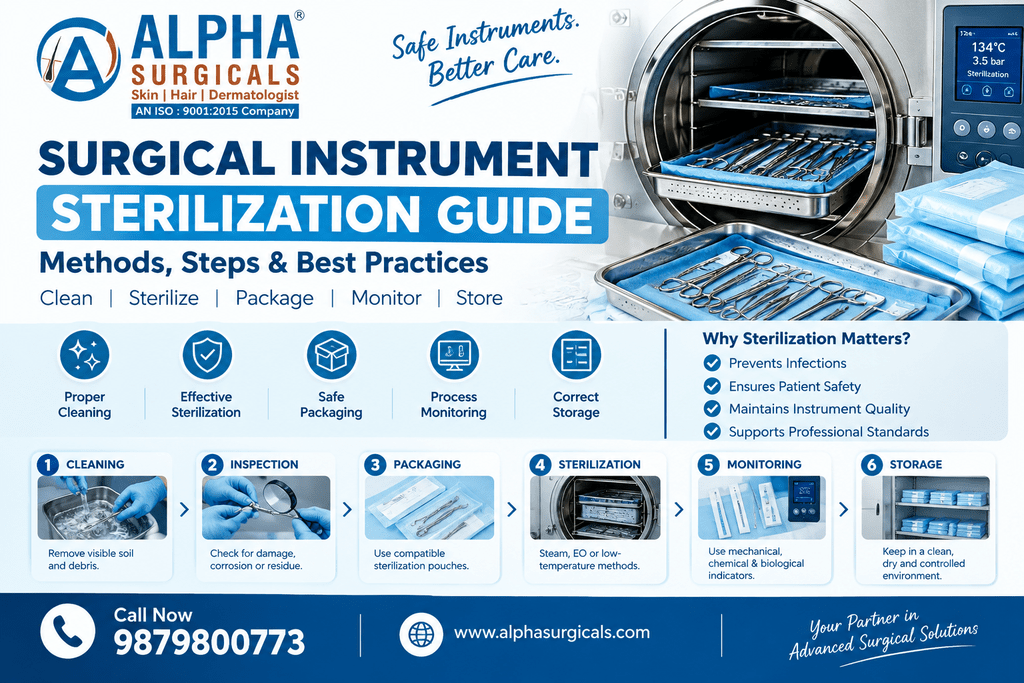
Step 4: Select the Appropriate Sterilization Method
Different instruments require different processing methods.
Steam Sterilization
Steam sterilization uses saturated steam under pressure. It remains a widely used and dependable method for heat- and moisture-stable critical instruments.
Therefore, many reusable surgical instruments can undergo autoclave processing when their manufacturer’s instructions permit it.
Low-Temperature Sterilization
Some medical devices cannot tolerate high temperatures or moisture.
For these devices, healthcare facilities may use suitable low-temperature technologies, such as ethylene oxide or hydrogen peroxide-based systems, when indicated and compatible with the device.
However, the facility should always follow the sterilizer, instrument, and packaging manufacturer’s validated instructions.
Step 5: Monitor the Sterilization Process
Monitoring is another important part of surgical instrument sterilization.
Healthcare facilities should use appropriate mechanical, chemical, and biological monitoring as part of their sterilization quality-control program.
Mechanical monitoring can include cycle parameters such as time, temperature, and pressure. In addition, chemical indicators can help show whether an item has been exposed to the required processing conditions.
Biological indicators provide another important method for evaluating sterilization effectiveness.
Consequently, facilities should document sterilization cycles and investigate any failed or inadequate indicators according to their established protocols.
Step 6: Store Sterile Instruments Correctly
After sterilization, protect packaged instruments from contamination and damage.
For example, storage areas should support the integrity of sterile packaging. Furthermore, staff should handle sterile packs appropriately and inspect packaging before use.
If packaging becomes wet, torn, punctured, or otherwise compromised, follow the facility’s reprocessing policy rather than assuming the item remains sterile.
Common Mistakes to Avoid
Proper surgical instrument sterilization requires more than placing instruments inside an autoclave.
Avoid these common problems:
- Skipping thorough cleaning
- Allowing blood or tissue to dry on instruments
- Overloading sterilizers
- Using an unsuitable sterilization cycle
- Ignoring manufacturer instructions
- Failing to monitor sterilization cycles
- Using damaged packaging
- Storing sterile instruments incorrectly
- Reusing single-use devices contrary to applicable requirements
Therefore, staff training and consistent quality-control procedures remain important parts of instrument reprocessing. WHO also emphasizes that correct processing requires several sequential steps and appropriate quality control.
Surgical Instrument Care and Maintenance
Proper care does not end after sterilization.
Instead, healthcare teams should maintain instruments according to the manufacturer’s recommendations. Regular inspection can help identify damage, corrosion, or functional problems before the next procedure.
Moreover, appropriate maintenance can help preserve the condition and performance of reusable surgical instruments.
Alpha Surgical: Professional Surgical Instruments
Alpha Surgical supplies professional medical and surgical products for dermatology, aesthetics, hair restoration, and related healthcare applications.
Furthermore, Alpha Surgical focuses on quality, reliability, and practical clinical requirements. Its product range supports professional healthcare environments where suitable instrument selection and proper instrument care matter.
For dermatology and surgical professionals, choosing suitable instruments is only one part of the process. In addition, proper cleaning, sterilization, maintenance, and storage help support an organized clinical workflow.
Surgical Instrument Sterilization: Key Takeaways
To summarize, effective surgical instrument sterilization depends on the complete reprocessing workflow rather than sterilization alone.
Remember these key points:
- Clean instruments thoroughly before sterilization.
- Inspect instruments after cleaning.
- Use compatible packaging.
- Choose the correct sterilization method.
- Follow manufacturer instructions.
- Monitor sterilization cycles.
- Maintain proper records.
- Store sterile instruments appropriately.
- Remove damaged or improperly processed instruments from use.
Ultimately, healthcare facilities should follow applicable regulations, professional standards, and manufacturer instructions for every instrument and sterilization system.
Choose Professional Surgical Instruments with Alpha Surgical
Alpha Surgical provides professional surgical and dermatology instruments for healthcare applications.
Follow us on Instagram : https://www.instagram.com/alphasurgicals?igsh=cTdjYWNtaXkxazlr
Follow us on Facebook : https://www.facebook.com/alphasurgicals/
Watch and learn suturing techniques : https://alphasurgicals.com/educational-surgical-videos/
Visit our store to purchase other products : https://alphasurgicals.com/store/