
In dermatology and aesthetic procedures, reliable medical connections play an important role in maintaining consistent instrument performance. Whether a practitioner uses syringes, needles, tubing or other compatible accessories, every connection must fit securely and function as intended.
Luer Lock Connections help create a secure connection between compatible medical components. Their threaded locking mechanism helps reduce accidental disconnection during handling and fluid transfer. However, proper compatibility, correct assembly and product quality remain equally important.
At Alpha Surgical, we understand the importance of dependable dermatology instruments and accessories. Selecting suitable connectors can support smoother clinical workflows, better handling and more reliable equipment performance.
What Are Luer Lock Connections?
Luer Lock Connections are small medical connector systems commonly used with compatible syringes, needles and fluid-transfer accessories.
They generally consist of two mating components:
- Male Luer connector: Features a tapered tip that fits into the corresponding female connector.
- Female Luer connector: Receives the male connector and may include a threaded collar or locking feature.
Unlike a simple push-fit connection, a Luer Lock system uses a threaded collar to help secure the joined components.
This design helps maintain a stable connection during routine handling. Nevertheless, users must select compatible components and follow the manufacturer’s instructions.
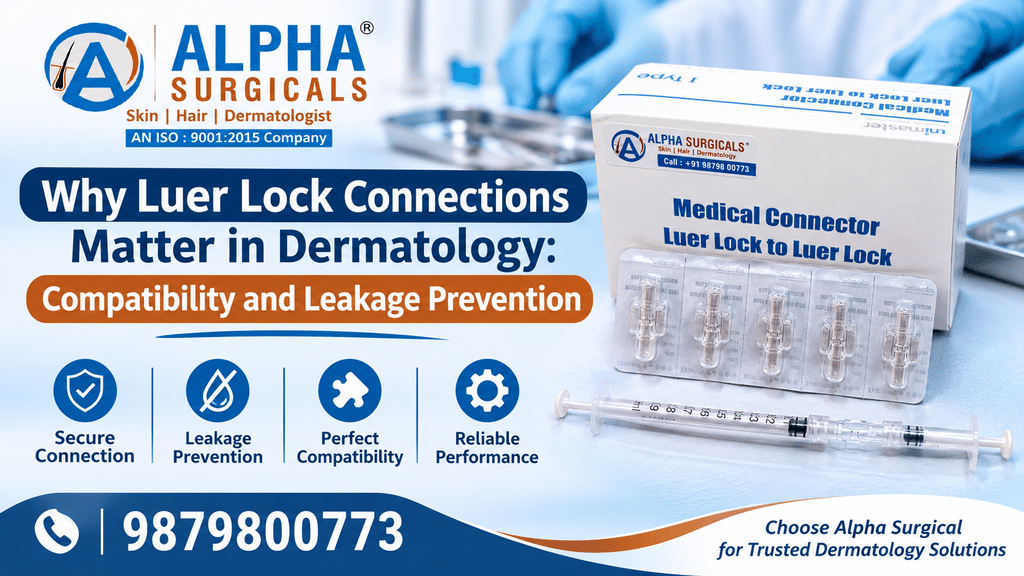
Why Luer Lock Connections Matter in Dermatology
Dermatology procedures often involve different instruments and accessories. Therefore, connector reliability can influence equipment handling and workflow consistency.
Here are some important reasons why Luer Lock Connections matter.
1. Secure Instrument Connections
A secure connection helps reduce the possibility of accidental separation while handling compatible equipment.
For example, practitioners may use syringes with compatible needles or accessories during different dermatological applications.
The threaded collar helps hold the components together. As a result, it can provide greater connection security than an unthreaded slip-fit design.
However, the locking feature does not eliminate every possibility of disconnection. Proper assembly and inspection remain essential.
2. Leakage Prevention
Fluid leakage can interrupt a procedure, waste materials and create additional handling concerns.
Luer Lock Connections help maintain contact between compatible connector surfaces. When manufacturers design and test these components according to applicable requirements, they can provide reliable fluid connections.
However, a Luer Lock mechanism alone does not guarantee a leak-proof connection.
Several factors can influence leakage:
- Connector manufacturing quality
- Correct dimensional compatibility
- Damaged or worn connector surfaces
- Improper assembly
- Excessive tightening or mechanical stress
- Incompatible accessories
Therefore, practitioners should inspect connectors before use and follow the manufacturer’s recommended handling instructions.
3. Better Compatibility Between Medical Accessories
Dermatology practices may use different syringes, needles, tubing systems and other medical accessories.
However, not every connector is automatically compatible with every medical device.
The ISO 80369-7 standard specifies dimensional and performance requirements for Luer connectors intended for intravascular or hypodermic applications.
Therefore, healthcare professionals should verify the connector type, intended application and manufacturer’s compatibility information before selecting accessories.
At Alpha Surgical, product selection should focus on suitability for the intended clinical application rather than connector appearance alone.
4. Improved Handling During Procedures
A stable connector can support smoother equipment handling during clinical workflows.
For example, the threaded collar helps secure compatible components when practitioners handle a syringe and an attached accessory.
Additionally, a properly selected connection can reduce unnecessary interruptions caused by loose or unsuitable fittings.
However, practitioners should avoid excessive tightening because unnecessary force may damage connector components.
5. Support for Consistent Clinical Workflows
Dermatology clinics depend on properly functioning instruments and accessories.
A reliable connection system can help practitioners organize equipment, prepare compatible components and maintain a consistent workflow.
Moreover, standardized connector dimensions can make it easier to identify suitable accessories when manufacturers specify the relevant compatibility requirements.
Luer Lock vs Luer Slip: Understanding the Difference
Both connector types use a tapered mating design, but their securing mechanisms differ.
| Feature | Luer Lock | Luer Slip |
|---|---|---|
| Connection method | Threaded locking collar | Push-fit connection |
| Securing mechanism | Screw-based collar | Friction between mating surfaces |
| Connection stability | Helps resist accidental separation | Depends on friction and correct fitting |
| Handling | Requires correct alignment and tightening | Requires correct push-fit assembly |
| Typical consideration | Applications requiring additional connection security | Applications where a slip connection is specified |
The right option depends on the medical device, procedure requirements and manufacturer’s instructions.
Importantly, a Luer Lock connection should not replace a different connector type when the device requires a specifically designed alternative.
Common Factors That Can Cause Luer Lock Leakage
Although Luer Lock Connections offer a secure design, certain issues can still affect their performance.
Incorrect Connector Compatibility
Using components that do not meet the required dimensional or application specifications may create an unreliable connection.
Damaged Connector Threads
Damaged or worn threads can affect the locking mechanism and prevent proper assembly.
Poor Manufacturing Quality
Inconsistent dimensions, surface defects or inadequate manufacturing controls can affect connector performance.
Incorrect Assembly
Misalignment or improper tightening may compromise the connection.
Excessive Mechanical Stress
Pulling, bending or applying unnecessary force to connected tubing and accessories can place stress on the connector.
To reduce these problems, healthcare professionals should select suitable products, inspect components and follow the manufacturer’s instructions.
How to Select Reliable Luer Lock Connections
Choosing suitable connectors requires more than checking whether two components appear to fit.
Consider the following factors:
- Dimensional compatibility: Confirm that the connector follows the relevant specifications for its intended application.
- Material quality: Review the manufacturer’s information about materials and product suitability.
- Manufacturing consistency: Select products from suppliers that provide appropriate quality documentation.
- Leakage performance: Check the available product specifications and applicable performance testing information.
- Intended application: Verify that the connector is designed for the specific medical device and clinical use.
- Manufacturer instructions: Follow the specified assembly, handling, storage and single-use or reuse requirements.
These considerations help healthcare professionals make informed purchasing decisions.
Understanding ISO Standards for Luer Lock Connectors
ISO 80369-7:2021 specifies dimensions and functional performance requirements for small-bore Luer connectors intended for intravascular and hypodermic applications.
The standard includes requirements relating to connector design and leakage performance.
This standard is particularly relevant when evaluating compatible syringes, needles and associated medical accessories.
However, it is important to understand that ISO 80369-7 does not establish universal compatibility for every dermatology instrument or medical accessory.
Always check the applicable product-specific requirements and manufacturer documentation before selecting a connector.
The Role of Alpha Surgical in Dermatology Instrument Selection
At Alpha Surgical, we recognize that dependable instruments and compatible accessories are important considerations for dermatology and aesthetic practices.
Our focus includes professional surgical and dermatology products designed to support practical clinical requirements.
When selecting medical accessories, healthcare professionals should consider:
- Reliable product quality
- Suitable connector compatibility
- Intended clinical application
- Appropriate product specifications
- Consistent instrument handling
By focusing on these factors, practitioners can make better-informed equipment decisions.
Alpha Surgical aims to support dermatology professionals with products that align with their instrument and accessory requirements.
Explore our product range at https://alphasurgicals.com/store/.
Conclusion
Luer Lock Connections play an important role in connecting compatible syringes, needles and medical accessories. Their threaded design helps reduce accidental separation, while suitable connector specifications and proper assembly support reliable fluid transfer.
However, effective leakage prevention requires more than a locking mechanism. Product quality, dimensional compatibility, correct handling and manufacturer instructions all matter.
For dermatology professionals, choosing appropriate accessories is an important part of maintaining dependable equipment performance.
Alpha Surgical remains committed to supporting dermatology and aesthetic professionals with practical surgical and medical product solutions.
Frequently Asked Questions (FAQs)
1. What are Luer Lock Connections used for?
Luer Lock Connections join compatible medical components, such as syringes, needles and fluid-transfer accessories, using a threaded locking mechanism.
2. Do Luer Lock Connections prevent leakage?
They help maintain a secure connection and reduce the risk of accidental separation. However, leakage prevention also depends on connector quality, compatibility, proper assembly and product specifications.
3. What is the difference between Luer Lock and Luer Slip?
Luer Lock connectors use a threaded collar to secure the connection, whereas Luer Slip connectors rely on a push-fit friction connection.
4. Are all Luer Lock connectors universally compatible?
No. Users must verify connector dimensions, intended applications and manufacturer compatibility information before connecting medical accessories.
5. Which ISO standard applies to Luer Lock connectors?
ISO 80369-7:2021 specifies requirements for Luer connectors intended for intravascular or hypodermic applications.
6. How can practitioners reduce leakage problems?
Practitioners should select compatible products, inspect connectors for damage, assemble them according to manufacturer instructions and avoid excessive mechanical stress.
7. Why is connector quality important in dermatology?
Suitable connector quality supports reliable equipment handling, helps reduce connection problems and contributes to consistent clinical workflows.
Call to Action
Looking for dependable dermatology and surgical instruments?
Choose Alpha Surgical for professional medical and surgical product solutions designed around practical clinical requirements.
Contact: 9879800773
Explore our product range and discover solutions for dermatology, aesthetic medicine and hair restoration.
Follow us on Instagram : https://www.instagram.com/alphasurgicals?igsh=cTdjYWNtaXkxazlr
Follow us on Facebook : https://www.facebook.com/alphasurgicals/
Watch and learn suturing techniques : https://alphasurgicals.com/educational-surgical-videos/
Visit our store to purchase other products : https://alphasurgicals.com/store/