
Platelet-rich plasma (PRP) has become an important area of interest in dermatology, aesthetic medicine and hair restoration. However, the quality of a PRP preparation depends on more than the blood collection process. Centrifugation technique, collection systems, handling and processing conditions can all influence the final platelet concentration and cellular composition.
The comparison of single-spin vs double-spin PRP is particularly relevant for healthcare professionals who want to understand how different preparation methods affect platelet recovery, consistency and product characteristics.
As Alpha Surgical connects with dermatology and aesthetic professionals through industry events such as the 14th DASIL World Congress in Kochi, these technical considerations offer valuable opportunities for education and discussion. Alpha Surgical supplies professional medical and surgical products, including products for dermatology, aesthetics and hair restoration.
In this article, we explain the differences between single-spin and double-spin PRP preparation, the factors that influence platelet concentration, and why selecting appropriate PRP tubes and preparation equipment matters.
What Is Platelet-Rich Plasma (PRP)?
Platelet-rich plasma is a blood-derived preparation that contains concentrated platelets in a plasma component. Platelets contain growth factors and other biologically active substances involved in normal tissue repair.
Healthcare professionals use PRP in selected clinical applications, including dermatology and hair restoration. However, PRP preparations can differ considerably in platelet concentration, leukocyte content, platelet recovery and other characteristics.
Therefore, the term PRP does not describe one standardized product. The preparation method and the equipment used can influence the composition of the final preparation.
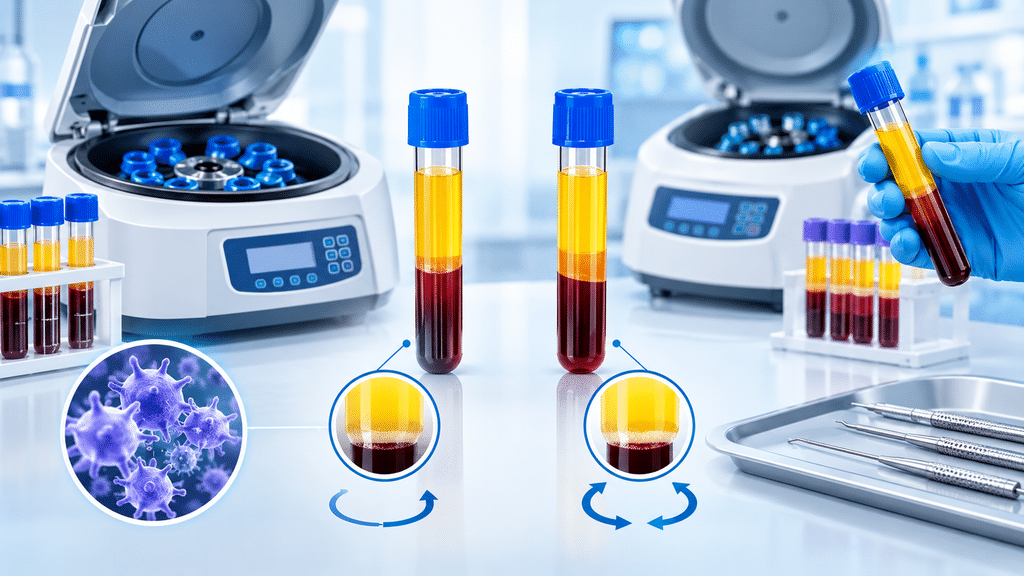
Single-Spin vs Double-Spin PRP: What Is the Difference?
The main difference between single-spin and double-spin PRP is the number of centrifugation stages used during preparation.
1. Single-Spin PRP Preparation
The single-spin method uses one centrifugation stage to separate blood components. Depending on the protocol and collection system, this process separates components according to their physical properties and allows the practitioner to collect the intended plasma fraction.
Potential characteristics of single-spin PRP include:
- A simpler preparation workflow.
- Fewer centrifugation stages.
- Potentially shorter processing time.
- Platelet recovery and cellular composition that depend on the selected protocol and collection system.
However, a single spin does not guarantee a particular platelet concentration. The centrifugation settings, tube design, blood characteristics and plasma collection technique all influence the final preparation.
2. Double-Spin PRP Preparation
The double-spin method uses two centrifugation stages. The first stage separates blood components, while the second stage further processes the selected fraction to help concentrate platelets.
Depending on the protocol, the second centrifugation stage can increase platelet concentration or alter the balance between platelets, leukocytes and other blood components.
Potential characteristics of double-spin PRP include:
- An additional processing stage.
- Greater control over the separation process when the protocol is appropriately designed.
- The potential to achieve a higher platelet concentration under suitable conditions.
- Additional time and handling requirements.
Nevertheless, double-spin preparation does not automatically produce superior PRP. Results depend on the centrifugation protocol, equipment, collection technique and the characteristics desired in the final product.
How Preparation Methods Influence Platelet Concentration
Platelet concentration is an important measurement when evaluating PRP. However, concentration alone does not fully describe preparation quality or predict clinical outcomes.
Several factors influence the final PRP composition.
1. Centrifugation Speed and Relative Centrifugal Force
Centrifugation separates blood components by applying centrifugal force. Although manufacturers and protocols may specify revolutions per minute (RPM), relative centrifugal force (RCF) more directly describes the force applied to the sample.
RPM alone does not fully define centrifugation conditions because the force also depends on the rotor radius.
Consequently, healthcare professionals should follow validated, device-specific protocols rather than assuming that the same RPM will produce identical results across different centrifuges.
2. Centrifugation Duration
The length of each centrifugation stage influences component separation. Too little or excessive processing may affect platelet recovery and the distribution of other blood components.
For this reason, practitioners should use the validated preparation protocol associated with their equipment and collection system.
3. PRP Tube Design and Collection System
PRP tubes can differ in material, dimensions, additives, separation features and intended use. These differences can influence how blood components separate and how practitioners collect the required fraction.
Therefore, choosing an appropriate tube is an important part of the preparation workflow.
At Alpha Surgical, PRP-related products are part of our broader offering for medical and aesthetic professionals. Practitioners should check each product’s specifications, intended use and compatibility with their preparation equipment before use.
4. Platelet Recovery and Cellular Composition
A high platelet concentration does not necessarily mean that the preparation contains the highest possible proportion of the original platelets. Concentration and platelet recovery are different measurements.
In addition, the number of leukocytes and red blood cells in the final preparation may vary according to the protocol and collection method.
Thus, professionals should evaluate the complete cellular composition when comparing PRP systems rather than relying on platelet concentration alone.
5. Handling and Preparation Consistency
Consistent handling supports reproducible preparation. Factors such as sample collection, timing, temperature, processing conditions and transfer technique can influence the final product.
Accordingly, healthcare facilities should establish documented procedures, train personnel and follow the equipment manufacturer’s instructions.
Single-Spin vs Double-Spin PRP: Comparison Table
| Feature | Single-spin PRP | Double-spin PRP |
|---|---|---|
| Centrifugation stages | One | Two |
| Workflow | Generally simpler | Includes an additional stage |
| Processing time | May be shorter | May be longer |
| Platelet concentration | Depends on the protocol | May increase with an appropriate second stage |
| Cellular composition | Depends on the collection system and settings | Depends on both centrifugation stages and collection technique |
| Equipment requirements | Compatible centrifuge and collection system | System suitable for the validated two-stage protocol |
| Best choice | Depends on the intended application | Depends on the intended application |
Neither method is universally superior. The appropriate choice depends on the target preparation, validated protocol, equipment and clinical application.
Why PRP Preparation Quality Matters in Dermatology and Hair Restoration
PRP preparation can influence the material that a healthcare professional ultimately uses. However, the relationship between platelet concentration and clinical outcomes is complex.
Researchers have reported considerable variation in PRP preparation methods and the reporting of platelet concentrations across clinical studies. Consequently, standardization and accurate documentation remain important considerations.
For dermatology and hair restoration professionals, relevant considerations include:
- The intended clinical application.
- The platelet concentration and recovery characteristics.
- Leukocyte and red blood cell content.
- The preparation system’s validated protocol.
- Product compatibility and handling requirements.
- Consistency between preparation sessions.
Furthermore, healthcare professionals should assess clinical evidence for the specific application instead of assuming that a higher platelet concentration will always produce a better outcome
Follow us on Instagram : https://www.instagram.com/alphasurgicals?igsh=cTdjYWNtaXkxazlr
Follow us on Facebook : https://www.facebook.com/alphasurgicals/
Watch and learn suturing techniques : https://alphasurgicals.com/educational-surgical-videos/
Visit our store to purchase other products : https://alphasurgicals.com/store/