
Platelet-rich plasma (PRP) preparation starts with an important component: the blood collection tube. Therefore, understanding the types of PRP tubes can help healthcare professionals choose a tube that matches the intended PRP preparation method and workflow.
PRP tubes are available with different anticoagulants and separator configurations. For example, some tubes use ACD-A, while others use sodium citrate. In addition, certain tubes include a gel separator. Some specialized products may also include biotin gel.
However, tube specifications can vary between manufacturers. Therefore, healthcare professionals should always check the product labeling, intended use, and instructions provided by the manufacturer.
What Are PRP Tubes?
PRP tubes are medical blood-collection tubes designed for use in PRP preparation workflows. The tube collects blood and can contain an anticoagulant, separator gel, or other components depending on its design.
Generally, the tube configuration influences how the collected blood is handled during processing. As a result, selecting an appropriate tube is an important part of a consistent PRP workflow.
The main types of PRP tubes discussed in this guide include:
- ACD-A liquid tubes
- ACD-A gel tubes
- Sodium citrate liquid tubes
- Sodium citrate gel tubes
- Biotin gel tubes
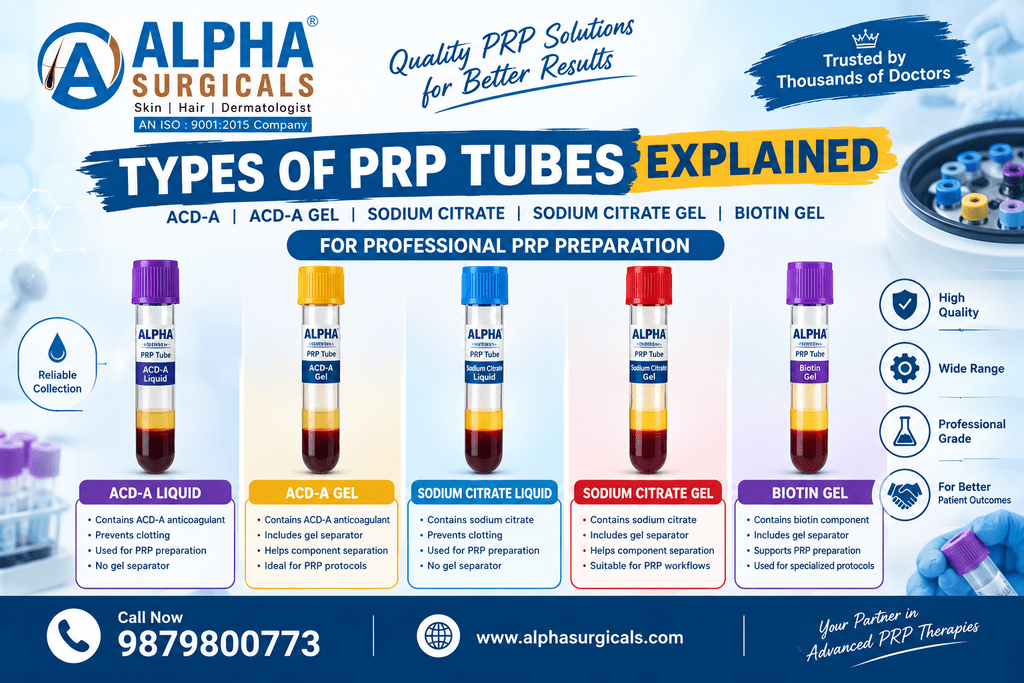
1. ACD-A Liquid PRP Tubes
ACD-A liquid tubes contain Acid Citrate Dextrose Solution-A (ACD-A), which functions as an anticoagulant during blood collection.
Because ACD-A helps prevent clot formation, it can support blood handling before PRP processing. Consequently, these tubes are commonly considered when a liquid anticoagulant configuration is preferred.
Key characteristics
- Contains ACD-A anticoagulant
- Uses a liquid anticoagulant configuration
- Supports blood collection before PRP processing
- Does not rely on a gel separator
- Suitable use depends on the manufacturer’s intended application
Therefore, professionals should follow the specific tube instructions when incorporating ACD-A tubes into a PRP workflow.
2. ACD-A Gel PRP Tubes
Next, ACD-A gel tubes combine an ACD-A anticoagulant with a gel separator.
The anticoagulant helps reduce clotting during collection. Meanwhile, the gel can provide separation between blood components during centrifugation, depending on the tube design and processing protocol.
As a result, ACD-A gel tubes offer a different configuration from standard ACD-A liquid tubes.
Key characteristics
- Contains ACD-A anticoagulant
- Includes a gel separator
- Combines anticoagulation and separation features
- Designed for specific PRP preparation workflows
- Requires use according to manufacturer instructions
Importantly, the performance of a gel separator depends on factors such as tube design, centrifugation conditions, and the manufacturer’s specifications.
3. Sodium Citrate Liquid PRP Tubes
Another option among the types of PRP tubes is the sodium citrate liquid tube.
These tubes use sodium citrate as the anticoagulant. The liquid formulation provides an alternative to ACD-A-based collection tubes.
Furthermore, sodium citrate tubes may be selected when the PRP preparation protocol specifically calls for citrate-based anticoagulation.
Key characteristics
- Contains sodium citrate anticoagulant
- Uses a liquid anticoagulant
- Does not contain a gel separator
- Supports blood collection before processing
- Application depends on the intended PRP protocol
However, healthcare professionals should compare the tube specifications before selecting a product for a particular clinical workflow.
4. Sodium Citrate Gel PRP Tubes
Sodium citrate gel tubes combine sodium citrate anticoagulation with a gel separator.
In this configuration, sodium citrate supports anticoagulation, while the gel provides a separation layer during processing when used according to the manufacturer’s protocol.
Therefore, this type can offer a different preparation setup compared with liquid sodium citrate tubes.
Key characteristics
- Contains sodium citrate
- Includes a gel separator
- Combines liquid anticoagulant and gel separation
- Designed for specific PRP preparation systems
- Requires appropriate centrifugation and handling
As with other types of PRP tubes, the exact tube specifications should be checked before use.
5. Biotin Gel PRP Tubes
Biotin gel tubes represent another specialized configuration found in some PRP tube product ranges.
These tubes may incorporate a gel separator along with biotin or a biotin-containing component, depending on the manufacturer’s formulation.
Because formulations can differ, professionals should not assume that all biotin gel tubes have identical properties. Instead, they should review the product label and manufacturer’s instructions for the exact composition and intended use.
Key characteristics
- Includes a gel-based configuration
- May contain a biotin-related component
- Designed for specific PRP preparation applications
- Product specifications can vary
- Manufacturer instructions should be followed carefully
ACD-A vs Sodium Citrate PRP Tubes
Both ACD-A and sodium citrate tubes are used as anticoagulant-based blood collection options. However, they are not identical.
| Feature | ACD-A Liquid | ACD-A Gel | Sodium Citrate Liquid | Sodium Citrate Gel |
|---|---|---|---|---|
| Anticoagulant | ACD-A | ACD-A | Sodium citrate | Sodium citrate |
| Gel separator | No | Yes | No | Yes |
| Configuration | Liquid | Liquid + gel | Liquid | Liquid + gel |
| Processing | Protocol dependent | Protocol dependent | Protocol dependent | Protocol dependent |
| Intended use | Check manufacturer | Check manufacturer | Check manufacturer | Check manufacturer |
Therefore, the best option depends on the PRP preparation protocol, tube specifications, centrifugation system, and intended application.
Liquid vs Gel PRP Tubes
The main difference between liquid and gel configurations is the presence of a separator gel.
Liquid tubes
Liquid tubes primarily provide an anticoagulant solution. Therefore, they are generally simpler in configuration and rely on the processing protocol for component separation.
Gel tubes
Gel tubes contain a separator material in addition to the anticoagulant or other tube components. During appropriate processing, the gel can form a barrier between blood components.
However, centrifugation requirements can vary significantly between products. For this reason, users should always follow the manufacturer’s recommended protocol.
How to Choose the Right PRP Tube?
Choosing among the types of PRP tubes requires attention to several factors.
1. Check the anticoagulant
First, identify whether the tube contains ACD-A or sodium citrate. The selected anticoagulant should match the intended preparation protocol.
2. Check for a gel separator
Next, determine whether the tube contains a separator gel. This feature can change the processing configuration.
3. Consider the processing system
Furthermore, check whether the tube is compatible with the centrifuge and PRP preparation workflow being used.
4. Review manufacturer instructions
Most importantly, always review the product specifications, intended use, processing instructions, and labeling.
5. Consider the intended application
Finally, healthcare professionals should select products according to their professional protocol and intended application rather than choosing a tube based only on its appearance or label.
Why PRP Tube Quality Matters
Consistent blood collection and processing are important parts of a controlled PRP workflow. Therefore, the tube should provide suitable construction, labeling, and compatibility for its intended application.
In addition, proper handling can help maintain consistency throughout the preparation process. Consequently, healthcare professionals should use tubes according to the manufacturer’s instructions.
Alpha Surgical – Professional PRP Tube Solutions
Alpha Surgical supplies professional medical and surgical products for dermatology, aesthetic medicine, hair restoration, and related healthcare applications.
Our product range includes PRP-related solutions designed to support professional healthcare workflows. In addition, Alpha Surgical focuses on quality, reliability, and practical clinical requirements.
Depending on product specifications, PRP tube options may include ACD-A liquid, ACD-A gel, sodium citrate liquid, sodium citrate gel, and biotin gel configurations.
Moreover, healthcare professionals can review the specific product specifications before selecting a tube for their workflow.
Alpha Surgical aims to provide reliable products that support professionals across dermatology, hair restoration, aesthetic medicine, and related applications.
Conclusion
The different types of PRP tubes offer varying configurations for blood collection and PRP preparation. ACD-A tubes use ACD-A anticoagulant, while sodium citrate tubes use sodium citrate. Meanwhile, gel tubes add a separator configuration, and specialized biotin gel tubes may provide another option depending on the manufacturer’s formulation.
Ultimately, the right tube should be selected according to the intended application, preparation protocol, centrifuge compatibility, and manufacturer’s instructions.
Explore professional PRP solutions from Alpha Surgical and choose products according to your clinical workflow and product specifications.
Follow us on Instagram : https://www.instagram.com/alphasurgicals?igsh=cTdjYWNtaXkxazlr
Follow us on Facebook : https://www.facebook.com/alphasurgicals/
Watch and learn suturing techniques : https://alphasurgicals.com/educational-surgical-videos/
Visit our store to purchase other products : https://alphasurgicals.com/store/